Lit for a Living: How a New Generation of Creators Turned Glowing Installations Into Real Careers
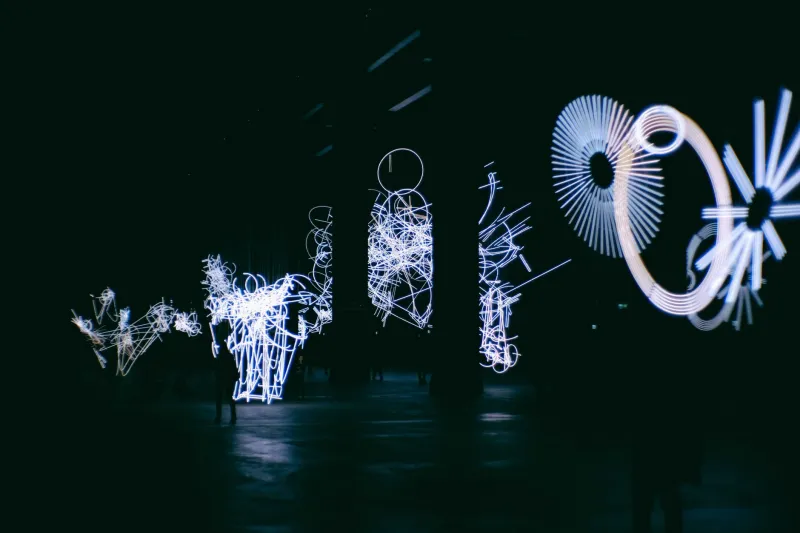
Four years ago, Marcus Webb was wiring LED strips in his garage in Nashville at midnight, trying to figure out how to make a custom sign for his sister's wedding without spending more than $200 in materials. Today, he runs a studio with two full-time employees, a waiting list that stretches three months, and a minimum project fee of $4,500. His work — large-scale interactive light sculptures for corporate events, private residences, and hospitality spaces — has appeared in hotel lobbies, tech company headquarters, and a vineyard wedding in Napa that got 40,000 Instagram impressions in a weekend.
"I didn't plan any of this," Webb says, laughing. "I just kept saying yes to things, and at some point I looked up and realized I had a business."
His story isn't unique. Across the US, a generation of makers, designers, and tinkerers has discovered that illuminated art — custom LED work, interactive light installations, immersive glow experiences — represents a genuine economic opportunity. The market is fragmented, the barrier to entry is relatively low, and demand keeps growing. But turning a talent for making things glow into a sustainable career requires more than good taste and a soldering iron. It requires learning how to price, how to market, and how to scale without losing the thing that made the work special in the first place.
The Etsy-to-Empire Pipeline
For many creators in this space, the journey starts the same way: a side project gets noticed, someone asks if it's for sale, and suddenly there's a business model hiding inside a hobby.
Jordan Reyes started selling small custom neon-style LED signs on Etsy from her apartment in Portland in 2020. Her early pieces — hand-lettered phrases in flexible LED tubing, mounted on acrylic backing — sold for $80 to $150 each. Within a year, she was pulling in $6,000 a month from the platform. Within two years, she'd moved into a studio, hired a part-time assistant, and started taking custom commissions for restaurants and retail spaces that ran into the thousands.
"Etsy taught me everything about customer psychology," Reyes says. "You learn really fast what people respond to, what makes them hit buy, and what makes them walk away. That knowledge is worth more than any business course."
Her current pricing for commercial installations starts at $2,500 for a small statement piece and tops out around $18,000 for large-scale custom work. She's turned down bigger projects — not because she couldn't execute them, but because she's learned to protect her production capacity. "If I take a $40,000 job that ties up my studio for three months, I lose all my smaller clients. Balance is everything."
The Event Economy Goldmine
If Etsy is the training ground, the event industry is where the real money lives. Weddings, corporate activations, brand launches, and private parties have developed an enormous appetite for experiential lighting — and they pay accordingly.
Danielle Park runs Luminary Creative Co. out of Dallas, specializing in immersive light installations for high-end events. Her company installs everything from cascading LED canopy systems for outdoor weddings to interactive light tunnel experiences for corporate conferences. A mid-range wedding installation runs $8,000 to $15,000. A corporate activation for a Fortune 500 brand launch can hit $75,000 or more.
"The event market is completely different from selling objects," Park explains. "You're not selling a product — you're selling a feeling, a moment, a photograph that the client's guests will post everywhere. The ROI for a brand is obvious. For a wedding couple, it's about creating something their guests will never forget. Both of those things have real dollar value."
The logistics are demanding. Event work means tight installation windows, unpredictable venues, and the ever-present risk that something fails at the worst possible moment. Park keeps a war chest of backup components and runs what she calls "failure rehearsals" — deliberate stress tests of every installation before it goes live. "In this business, your reputation is everything. One catastrophic failure at a high-profile event and you're done. So you over-engineer everything."
Social Media as the Showroom
Ask any successful creator in this space how they get clients and the answer is almost always the same: Instagram, TikTok, and the algorithmic magic of a video that happens to go viral.
Light installations are inherently photogenic. A well-shot video of an LED tunnel, a glowing sculpture, or an interactive installation that responds to movement can rack up millions of views without any advertising spend. Marcus Webb's first viral moment — a time-lapse of a full hotel lobby installation he posted on a whim — generated 200 direct inquiries in 72 hours. He landed four projects from that single post.
"Social media is your portfolio, your sales team, and your marketing department all in one," he says. "But you have to feed it constantly. The algorithm doesn't care that you had a great post six months ago."
The creators who thrive have learned to document obsessively — not just finished installations, but the process, the problem-solving, the behind-the-scenes moments. Audiences respond to authenticity and craft. A video showing how a complex LED matrix gets programmed and wired often outperforms a polished final reveal. The work itself is the content.
The Gap Between Hobbyists and Professionals
For every creator who's made the leap to full-time, there are dozens who are still trying to figure out how to cross the gap. The hobby space is enormous — DIY LED communities on Reddit, YouTube tutorials with millions of views, maker spaces in every major city full of people experimenting with light. But translating that enthusiasm into income is harder than it looks.
Pricing is where most hobbyists stumble. The instinct is to undercharge — to price based on materials and time at minimum wage, without accounting for overhead, expertise, or the simple fact that professional-grade work commands professional-grade rates. "I see people in Facebook groups selling custom pieces for $150 that should be $600," says Reyes. "They're not building a business — they're subsidizing someone else's décor."
The other gap is reliability. Clients paying four or five figures for an installation need to know that the person they're hiring will show up on time, communicate clearly, and deliver exactly what was promised. That professional infrastructure — contracts, project management, client communication — is what separates a talented maker from a viable business.
What the Market Looks Like From Here
The demand signals are strong. The experiential economy keeps expanding. Consumers and brands alike are investing more in environments and moments rather than things. Residential interior design has fully embraced statement lighting as a design element, not an afterthought. And the technology keeps getting better and cheaper — LED controllers, programmable strips, and interactive sensors that would have cost thousands five years ago are now accessible to anyone with a laptop and a weekend to learn.
For the creators who've already made it work, the opportunity feels wide open. "There's no ceiling I can see," says Park. "Every venue, every brand, every couple getting married is a potential client. The market isn't saturated — it's barely started."
Marcus Webb, back in Nashville, is already thinking about his next move: a permanent installation gallery where clients can experience his work before commissioning it. "I want people to walk in and feel it," he says. "That's the thing about light — you can't really explain it. You have to stand inside it."
That, in the end, might be the whole business model: creating something so beautiful, so immersive, so impossible to ignore that people simply can't help but reach for their wallets.