The Art of Nothing: How American Artists Are Making Darkness Do All the Work
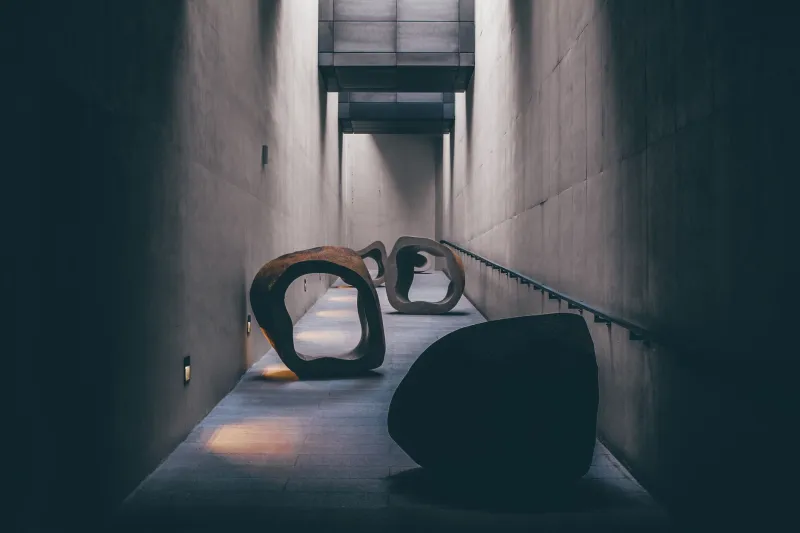
There's a moment — you've probably felt it — when you walk into a darkened room and something shifts. Not fear exactly, but a kind of heightened attention. Your eyes adjust, your breath slows, and suddenly the sliver of light cutting across the floor feels like the most important thing in the world. A growing group of American artists lives for that moment. And they're engineering it on purpose.
While the broader world of illuminated art tends to celebrate brightness — the more lumens, the better — a distinct countermovement has been gaining traction across the US. These are the shadow artists, the contrast sculptors, the designers who treat darkness not as the absence of their medium but as the medium itself. Their work is quieter than a neon installation, harder to photograph, and often more emotionally devastating for it.
Darkness as a Design Choice, Not a Default
It's worth pausing on how radical this actually is. Most of us are conditioned to think of art under good lighting — museum-quality, evenly distributed, flattering. Even within the world of light art, the instinct is usually to add more: more color, more intensity, more spectacle. Shadow artists push back against all of that.
Take Renata Voss, a Brooklyn-based installation artist who has spent the last decade working almost exclusively with a single bare bulb and hand-cut paper screens. Her process sounds almost absurdly simple until you see it. By shifting the angle of a light source by just a few degrees, she can transform a flat paper cutout into something that appears to breathe. Her 2022 installation Fault Lines, shown at a converted warehouse in Bushwick, used nothing more than six light sources and a series of suspended panels to cast shadows that changed completely as viewers moved through the space. People who saw it described it as "walking through a memory" — which is exactly what Voss was going for.
"Light tells you what to see," she said in a 2023 interview. "Shadow asks you to decide."
The West Coast Contrast Workers
Out in Los Angeles, a looser collective of projection artists has been doing something different but equally intentional. Rather than working with physical objects, they manipulate light digitally — but the goal isn't brightness. It's the precise calibration of contrast, using high-intensity projection to carve darkness into shapes that register as almost architectural.
Marco Delgado, one of the more recognizable names in this space, creates large-scale projection pieces that look, at first glance, like black paintings. Spend a few minutes with them and figures begin to emerge — not because they're illuminated, but because the surrounding light has been so carefully constructed that your eye fills in the gaps. It's a trick borrowed from classical painting (think Caravaggio's dramatic chiaroscuro) but executed at room scale and in real time.
Delgado's permanent piece in a Silver Lake cultural center draws a steady stream of visitors who often describe standing in front of it for far longer than they expected. "I didn't realize I was crying until I was already doing it," one visitor wrote in an online forum dedicated to LA art spaces. That's the shadow effect — it sneaks up on you.
Negative Space as Narrative
In the American Southwest, where the landscape itself plays with light and shadow in ways that feel almost theatrical, artists have long drawn inspiration from the environment. But a newer generation is turning that relationship inside out — bringing the desert's shadow logic into controlled gallery settings.
Santa Fe-based artist Juniper Alcott works with what she calls "negative-space portraiture" — a practice that involves lighting a subject from every angle except the one that would actually illuminate the face. The result is a portrait made entirely of shadow, where the subject's presence is implied rather than shown. Her series The Unnamed, which toured several New Mexico and Arizona galleries in 2023, dealt with themes of Indigenous erasure and historical invisibility. The formal choice — making subjects visible only through their absence of light — wasn't decorative. It was the argument.
This is where shadow art gets genuinely powerful as a cultural form. Light, in many artistic traditions, is associated with revelation, knowledge, heroism. Darkness carries the opposite connotations. Artists like Alcott are deliberately inverting that hierarchy, asking viewers to sit with what gets left in the dark and consider why.
The Emotional Physics of Low Light
There's actual science behind why shadow installations tend to produce such strong emotional responses. Research in environmental psychology has consistently shown that lower light levels increase feelings of intimacy and emotional openness. Dim environments reduce our sense of social performance — we're less worried about being seen — which paradoxically makes us more receptive to feeling things.
Shadow artists, even those who haven't read the research, seem to understand this intuitively. "I want people to feel like they can be honest in the space," says Chicago-based designer and light artist Priya Mehta, whose studio creates shadow-heavy environments for both gallery settings and commercial clients. "When everything is bright and visible, you're on. In the dark, you're off — and that's when art can actually reach you."
Mehta's recent gallery project Shelter used a series of overlapping shadow cones to create distinct zones within a single open room — some areas nearly pitch dark, others touched by just enough light to read the expressions of whoever was standing there. Visitors instinctively lowered their voices. Some sat down on the floor. It had the atmosphere of somewhere sacred, built entirely from a few carefully positioned light sources and a lot of deliberate nothing.
Why This Matters for the Future of Light Art
The illuminated art world is, broadly speaking, having a moment. Immersive light exhibitions sell out in hours. Neon installations become Instagram landmarks overnight. There's an appetite for visual spectacle that shows no sign of slowing down.
But the shadow movement offers something that pure spectacle rarely does: duration. These are works you stay with. Works that change as you move, that reward patience, that don't give everything up in the first thirty seconds. In an attention economy that's constantly competing for the fastest possible hit, that's actually a pretty subversive proposition.
The artists working in darkness aren't rejecting light — they're just being more honest about its relationship with shadow. You can't have one without the other. And sometimes the most powerful thing a light source can do is show you exactly where it isn't shining.
That's the art of nothing. And it's one of the most compelling things happening in American visual culture right now.