The People's Glow: How Cheap LEDs and Smart Bulbs Are Turning Regular Homes Into Light Art Galleries
The People's Glow: How Cheap LEDs and Smart Bulbs Are Turning Regular Homes Into Light Art Galleries
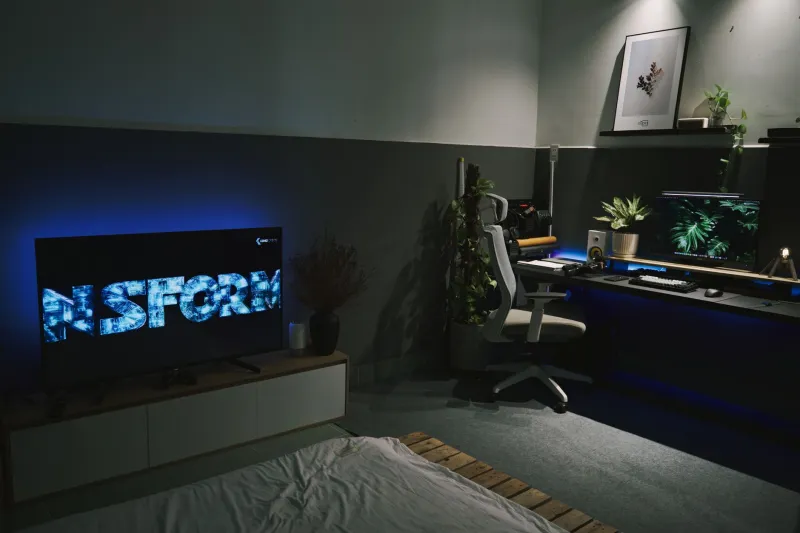
There's a bedroom in Columbus, Ohio that looks like it belongs inside a contemporary art museum. Gradient washes of amber and violet drift slowly across the ceiling. LED strips tucked behind a floating shelf create a soft halo effect that shifts with the time of day. The whole room breathes, almost. Its designer is not a professional artist. She's a pediatric nurse named Dana Kowalski, and she built the whole thing over three weekends for under four hundred dollars.
"I'd seen Teamlab's work online, all those projections and glowing environments, and I just thought — why can't my room feel like that?" she says. "Turns out, it kind of can."
Dana's story isn't unusual anymore. Across the country, everyday Americans are quietly transforming their bedrooms, basements, and backyards into immersive illuminated spaces — drawing inspiration from professional light art installations and pulling it off with consumer tech that, just a few years ago, would have seemed almost laughably ambitious for a home setting.
The Price Drop That Changed Everything
To understand how we got here, you have to look at what happened to the cost of LED technology over the past decade. In 2010, a single smart LED bulb could run you thirty dollars or more. Today, you can grab a multicolor smart bulb for five bucks and a sixteen-foot strip of app-controlled LEDs for under twenty. The manufacturing scale-up — driven largely by demand from commercial signage, stage production, and the gaming industry — had an unexpected side effect: it democratized a tool that was once the exclusive domain of professional lighting designers.
Platforms like Philips Hue, LIFX, and Govee didn't just make the hardware affordable. They built ecosystems around it — apps, integrations with music and video, scene libraries, and online communities where users share their setups like recipes. The learning curve dropped. The creative ceiling rose.
"It used to be that doing anything interesting with light required either an electrician or a serious budget," says Marcus Webb, a lighting designer based in Chicago who has worked on both theatrical productions and residential projects. "Now someone with zero technical background can create layered, dynamic lighting environments that are genuinely sophisticated. That's a real shift."
Basements, Backyards, and Bedrooms Reimagined
In Tucson, Arizona, retired high school art teacher Ray Espinoza has spent the past two years converting his backyard into what he calls his "outdoor canvas." Low-profile ground stakes with color-changing LEDs line the perimeter of his desert garden. String lights with individually programmable nodes arc between two mesquite trees. A small water feature is lit from beneath with submersible LEDs that cycle through warm golds and deep teals after sundown.
"I've always been drawn to how James Turrell plays with perception — how light can make you question the space you're in," Ray explains, referencing the celebrated American light artist whose work fills entire rooms with colored luminescence. "I'm not James Turrell. But I can create a moment in my backyard where my grandkids stop and just look up. That matters to me."
Meanwhile, in a suburb of Minneapolis, twenty-six-year-old Priya Nair has turned her basement into something closer to a club-meets-gallery hybrid. She uses a combination of Govee LED panels, bias lighting behind a large monitor, and a custom Raspberry Pi setup she programmed herself to sync light color and intensity to whatever music is playing. The effect — which she documents on her Instagram and TikTok accounts — has earned her a following of over forty thousand people who are, in many cases, trying to replicate her work in their own spaces.
"People DM me every day asking for my setup," Priya says. "I just share everything. The whole point is that anyone can do this."
Community as Catalyst
That spirit of open sharing is a defining feature of this movement. Reddit communities like r/led and r/homeautomation have become de facto galleries and workshops, where enthusiasts post photos of their setups alongside wiring diagrams and product lists. YouTube channels dedicated entirely to smart home lighting have racked up millions of subscribers. Discord servers host real-time troubleshooting sessions where beginners get walked through their first installation by people who were beginners themselves six months earlier.
This peer-to-peer education model has accelerated what might otherwise have taken years of solo experimentation. People aren't just copying each other — they're iterating, improving, and pushing the aesthetic further. The result is a genuinely evolving folk art tradition built around light.
"What strikes me is how much genuine visual intelligence is showing up in these home setups," says interior design writer and blogger Cassandra Fitch, who covers the intersection of technology and home aesthetics. "These aren't people just slapping some LED strips under their bed. They're thinking about color temperature, about how light interacts with texture and shadow. That's real design thinking."
Not Just Pretty — Purposeful
For many home light artists, the motivation goes beyond aesthetics. Dana, the Columbus nurse, started her project during a particularly grueling stretch of overnight shifts. "I came home one morning and just needed my space to feel like a refuge," she says. "Playing with the lighting became meditative. It still is."
Research increasingly supports the idea that dynamic, tunable lighting has measurable effects on mood and even sleep quality — something that the professional wellness industry has known for years but that consumer technology has only recently made accessible at scale. The fact that it also happens to look beautiful is almost a bonus.
Ray in Tucson puts it simply: "Light has always been art. The pharaohs knew it. The cathedral builders knew it. We just finally have the tools to do it ourselves."
The Gallery Is Wherever You Are
There's something quietly radical about what's happening in American homes right now. For most of human history, the ability to shape light as a creative medium — beyond a candle or a fireplace — required resources, expertise, or institutional access. Museums commissioned it. Casinos paid for it. Festivals budgeted for it. Everyone else just visited.
That boundary has dissolved. The same aesthetic impulse that drives a Teamlab installation or a Burning Man light sculpture is now finding expression in a Minneapolis basement, a Tucson backyard, a Columbus bedroom. The scale is different. The budgets are wildly different. But the intention — to transform a space through light, to make someone stop and feel something — is exactly the same.
The gallery, it turns out, was always just waiting for the right light.