Burning Bright: The Indigenous Fire Traditions That Gave Birth to American Light Art
When we talk about light as art, we tend to reach for the recent stuff — the immersive LED galleries, the neon-drenched murals, the projection-mapped building facades that make downtown feel like a dream. But if you pull back the timeline a little further, a whole other world opens up. One that smells like cedar smoke and pine resin. One that has been burning steadily, in one form or another, for thousands of years.
Across the United States, Indigenous communities have long practiced ceremonial and artistic traditions built around fire and light. These aren't museum relics or historical footnotes. They're living, breathing art forms — and they've had more influence on contemporary American fire art than most people realize.
Fire as the First Medium
Before pigment, before canvas, before any material we'd recognize as an "art supply," there was fire. For many Indigenous nations, flame was never just functional — it was communicative. It marked transitions. It honored the dead. It called in the harvest and gave thanks after it arrived.
Among the Pueblo peoples of the Southwest, fire ceremonies tied to the winter solstice have been practiced for centuries. The positioning of flames, the timing of their lighting, and even the specific wood used all carried meaning. In the Pacific Northwest, the Lummi Nation and neighboring tribes incorporated torch-lit processions into potlatch ceremonies — elaborate gatherings where art, gift-giving, and community identity all converged under the glow of open flame.
Further east, the Cherokee tradition of the Green Corn Ceremony included the ritual extinguishing and relighting of communal fires — a symbolic reset, a collective renewal, expressed entirely through the choreography of light and darkness.
These weren't decorative choices. They were design decisions, made with intention and passed down with care.
The Controlled Burn as Art Form
One of the most visually striking — and most misunderstood — Indigenous light traditions is the controlled burn. Often discussed in ecological terms (and rightly so, given its role in land stewardship), the practice also has a deeply aesthetic dimension that gets overlooked.
Tribes across California, the Great Plains, and the Southeast used controlled burns to shape landscapes in ways that were simultaneously practical and beautiful. The Karuk, Yurok, and Hupa peoples of Northern California, for example, developed burn practices over millennia that transformed hillsides into open, luminous meadows. At dusk, a freshly burned landscape glows differently — the contrast of blackened earth against surviving greenery, the way light catches new growth, the smell of transformation still hanging in the air. It was environmental art on a massive scale, authored collectively.
Several contemporary fire artists have pointed to this tradition as a direct influence. "When I think about what I'm doing with fire performance, I keep coming back to the idea that the landscape itself can be a canvas," says Marcus Threebears, a mixed-heritage fire sculptor based in Albuquerque whose work draws on Diné ceremonial aesthetics. "The controlled burn is one of the most sophisticated light-art concepts ever developed. We're just now catching up to it."
Lantern Traditions and the Glow of Story
Not all Indigenous light art is about open flame. Across the Great Lakes region, tribes including the Ojibwe developed traditions involving birchbark lanterns and firelit storytelling structures that functioned something like early installation art — immersive, atmospheric, designed to hold an audience inside a particular emotional and spiritual space.
These lantern traditions, while less widely documented than fire ceremonies, have found new life in the hands of contemporary artists. Lena Swiftwind, an Ojibwe-descended visual artist and light designer based in Minneapolis, has spent the last decade reconstructing and reimagining birchbark lantern forms for gallery contexts. Her installations — which combine traditional materials with modern LED underlighting — have shown at the Minneapolis Institute of Art and several regional Indigenous arts festivals.
"There's this assumption that traditional and contemporary are opposites," she told us. "But when I'm designing a piece, I'm doing exactly what my ancestors did — I'm asking how light can hold a story. The materials have changed. The question hasn't."
How These Roots Grow Into Modern Fire Art
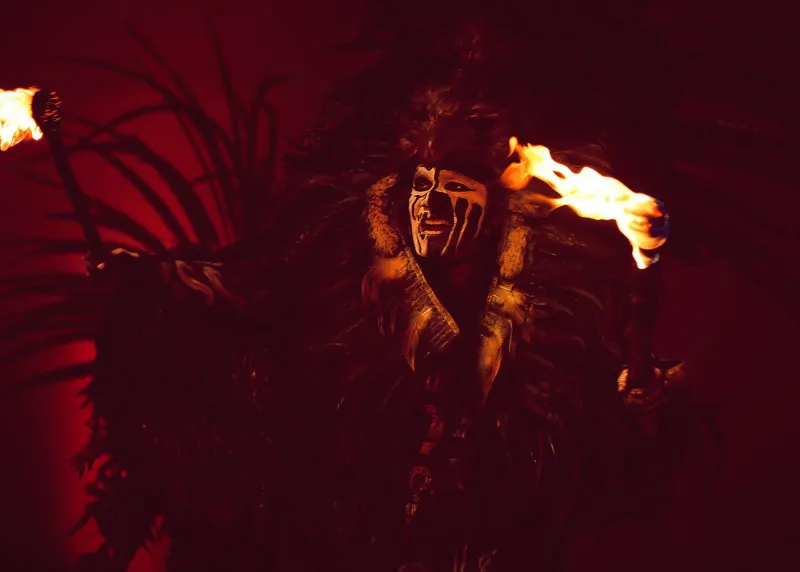
The contemporary American fire arts scene — which includes everything from fire dancing at festivals like Burning Man to large-scale pyrotechnic theater — owes more to Indigenous tradition than its practitioners often acknowledge. Part of that is simple cultural amnesia. Part of it is the way fire performance got absorbed into countercultural movements in the late 20th century, which brought its own mythology and tended to obscure older lineages.
But a growing number of artists are working deliberately to close that gap. Fire performer and choreographer Delia Runningwater, who is Lakota and performs with a Denver-based fire troupe called Ember Collective, describes her work as a kind of translation. "I'm not trying to recreate ceremony," she explains. "That's sacred and it belongs in its own context. What I'm doing is taking the underlying language — the way fire communicates, the way it commands attention, the way it transforms a space — and speaking it in a new dialect."
That underlying language is what connects a solstice fire in a Pueblo village to a pyrotechnic installation in a contemporary art gallery. It's the fundamental grammar of illuminated experience: light against darkness, warmth against the unknown, the moving flame as a stand-in for everything alive and impermanent.
Keeping the Flame
For all its vitality, this tradition faces real pressures. Controlled burn practices have been restricted by state and federal land management policies for decades, disrupting both ecological and cultural continuity. Ceremonial fire traditions are vulnerable to documentation loss as elder knowledge-keepers pass on. And the commercial fire arts world, while growing, doesn't always create space for practitioners working from Indigenous roots.
Organizations like the First Nations Fire Arts Collective (based in Santa Fe) and the Indigenous Arts Collaborative in the Twin Cities are working to change that — funding residencies, supporting intergenerational knowledge transfer, and advocating for the inclusion of Indigenous fire artists in mainstream arts programming.
The work matters. Because when you watch a fire performer move through a darkened stage, or stand at the edge of a controlled burn as the light shifts across a hillside, you're not watching something new. You're watching something ancient, doing what it has always done — turning flame into meaning, and meaning into art.
That's been true for thousands of years on this continent. It's still true tonight.