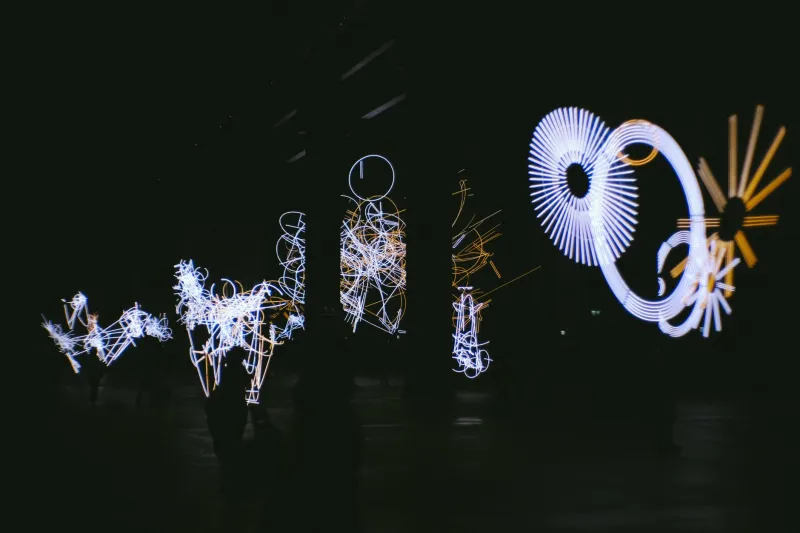
Always Moving, Always Glowing: How Kinetic Light Artists Are Reinventing Public Space
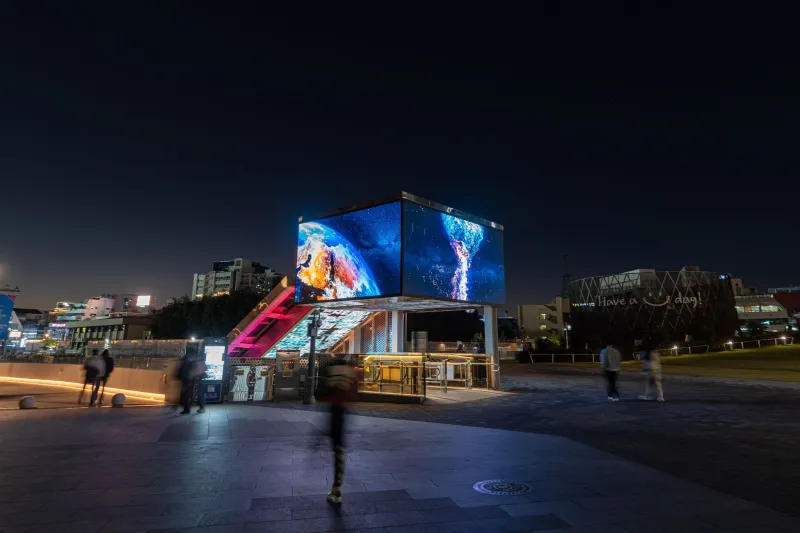
The first thing you notice is that it's breathing.
Not literally, of course — it's a sculpture made of aluminum armatures and programmable LED panels, suspended above a pedestrian plaza in downtown Denver. But the way the light pulses across its surface, expanding and contracting in slow, rhythmic waves, makes something in your brain read it as alive. People stop walking. They look up. A few of them hold out their hands, as if the light might land on them like a bird.
This is kinetic illumination, and it's quietly becoming one of the most exciting things happening in American public art.
Beyond the Static Glow
For a long time, light art meant something you looked at — a neon sign, a projection mapped onto a building, an LED installation frozen in a single configuration. Beautiful, sure. Impactful, often. But fundamentally passive. The light did its thing; you watched.
Kinetic light art breaks that contract. The defining characteristic of the movement is that the work is never the same twice. Light sequences shift in response to environmental data, human presence, sound, or pre-programmed choreography that unfolds over hours or days. The piece you see at noon is different from the one you catch at 8 p.m. Come back next Tuesday and it'll be different again.
"Static work is a sentence," says Priya Anand, a Brooklyn-based artist whose large-scale kinetic installations have appeared in Chicago, Houston, and San Francisco. "Kinetic work is a conversation. It keeps going after you leave."
Anand's pieces typically combine motorized structural elements — rotating panels, oscillating frames, suspended components that drift on programmed axes — with light sources choreographed to interact with the movement. The result is something that casts different shadows at different moments, creates new color relationships as angles shift, and generates a visual experience that genuinely can't be captured in a single photograph.
That last point is intentional. "I want people to have to be there," she says. "The Instagram photo can't hold the whole thing. That's kind of the point."
The Technology Behind the Magic
Kinetic light art sits at the intersection of several fields that didn't used to talk to each other much: sculpture, electrical engineering, software development, and architectural design. The artists working in this space tend to be unusually cross-disciplinary — or they build unusually cross-disciplinary teams.
On the hardware side, the explosion of affordable, high-quality LED technology over the last decade has been transformative. Individually addressable LED strips and panels allow artists to program light at the pixel level, creating gradients, animations, and responsive behaviors that would have required enormous budgets just 15 years ago. Combine that with servo motors, pneumatic actuators, and microcontrollers like Arduino or Raspberry Pi, and you have a toolkit that makes complex kinetic behavior accessible to artists who aren't necessarily engineers.
Software is the other piece of the puzzle. Programs like TouchDesigner — a visual development platform widely used in the live performance and installation world — allow artists to build sophisticated control systems that link light behavior to sensor inputs, audio signals, or generalized data streams. An installation might dim and brighten in response to ambient noise levels, shift color based on the number of people detected in a space, or run through a 24-hour light cycle that mirrors the actual movement of the sun.
"The tools have democratized this," says James Okafor, a Detroit-based artist and educator who teaches kinetic design at the College for Creative Studies. "You don't need a million-dollar fabrication budget anymore. You need time, curiosity, and a willingness to break things and start over."
Cities as Collaborators
One of the most interesting dynamics in the kinetic light art world is the relationship between artists and the cities commissioning their work. Public art budgets have traditionally favored permanent, low-maintenance installations — sculptures, murals, things that don't require software updates. Kinetic work challenges that model.
But cities are coming around, partly because the return on investment in terms of foot traffic and social media attention has been hard to ignore. A kinetic light installation that draws crowds, generates content, and gets people talking about a neighborhood is valuable in ways that city planners increasingly know how to quantify.
Phoenix, Pittsburgh, and Seattle have all commissioned significant kinetic light pieces in the last five years, and a number of cities have created dedicated public art funds specifically for time-based and technology-driven work. The National Endowment for the Arts has also expanded its support for interdisciplinary public installations, recognizing that the boundaries between art, technology, and urban design are dissolving fast.
"Cities are starting to think of kinetic art as infrastructure," says urban planner and public art advocate Leah Torres, who has consulted on projects in Los Angeles and Miami. "It activates space. It makes people want to be somewhere. That has real economic value."
When the Audience Becomes Part of the Work
The most exciting frontier in kinetic light art right now is interactivity — installations that don't just move on their own but respond directly to the people around them.
Think pressure-sensitive floors that trigger light patterns as you walk across them. Microphone arrays that translate crowd noise into color shifts. Camera systems that track movement and generate corresponding visual echoes in a nearby light array. These pieces don't just invite you to watch; they make you a participant, whether you realize it or not.
Artist collective LightForm Lab, based in Austin, has built their entire practice around this idea. Their installation Reciprocal, which appeared at a public plaza in Nashville last spring, used overhead sensors to track pedestrian movement and generate real-time light responses on a grid of suspended panels above the walkway. Walk quickly and the lights ahead of you surged. Stop and they settled into a slow, meditative pulse. Walk in a group and the system created harmonic patterns that merged individual light signatures into something collective.
"We wanted people to feel like the space knew they were there," says LightForm co-founder Raya Simmons. "Not in a surveillance way — in a welcoming way. Like the city was paying attention."
The piece ran for six weeks. By the end, regulars were coming back specifically to experiment with how their movements affected the light. Some brought friends to show them. A few came alone, late at night, just to have the experience to themselves.
What Comes Next
Kinetic light art is still a young discipline, and the artists working in it are the first to say they're figuring it out as they go. Questions about longevity, maintenance, and what happens when the technology that powers a piece becomes obsolete are real ones that the field is actively wrestling with.
But the direction of travel feels clear. As cities become more comfortable commissioning technology-driven public work, and as the tools to create it become more accessible, kinetic illumination is going to become a bigger part of how Americans experience urban space.
For now, if you want to find it, you have to go looking. Check public art databases, follow the artists on social media, pay attention to what's going up in your city's plazas and transit hubs. Then go stand underneath it for a while.
Let it breathe at you. You might be surprised how much you breathe back.