Nature's Own Light Show: Inside America's Bioluminescence Obsession
Nature's Own Light Show: Inside America's Bioluminescence Obsession
There's a moment that every bioluminescence hunter describes the same way. You're standing in total darkness — maybe knee-deep in warm saltwater, maybe crouched in a damp Tennessee forest — and then it happens. A wave breaks and the water turns electric blue. Or a fallen log begins to pulse with an eerie, soft green glow. Or a thousand tiny lights rise from a meadow in perfect, rippling unison. And just like that, you understand why people rearrange their entire vacation calendars around this stuff.
Across the country, a loose but enthusiastic community of nature lovers, photographers, and just flat-out curious people have made bioluminescence hunting their thing. Not in a fringe, conspiracy-theory-forum kind of way — more like birding, but with a serious wow factor and a much better Instagram return. These folks are chasing natural light art that no human hand designed, and the results are genuinely jaw-dropping.
What Is Bioluminescence, Actually?
At its core, bioluminescence is light produced by a living organism through a chemical reaction. The most common version involves a molecule called luciferin reacting with oxygen, catalyzed by an enzyme called luciferase. The result? Cold, living light. No heat, no electricity, no installation crew required.
It shows up in a wild range of species — marine plankton, fungi, fireflies, deep-sea fish, and even some types of bacteria. Each one produces light for a different reason: attracting mates, luring prey, confusing predators, or in some cases, reasons scientists still don't fully understand. What they all share is an almost supernatural beauty that tends to stop people cold the first time they see it.
For anyone who spends time thinking about illuminated art and design — the way light shapes experience, the way it creates emotion — bioluminescence is kind of the ultimate origin story. This is where the concept began.
The Glowing Bays of Puerto Rico
Okay, technically Puerto Rico is a US territory, not a state — but it's absolutely on the radar of every serious bioluminescence hunter in the country, and it absolutely counts. The island is home to three bioluminescent bays, and Mosquito Bay on the island of Vieques is widely considered the brightest in the world.
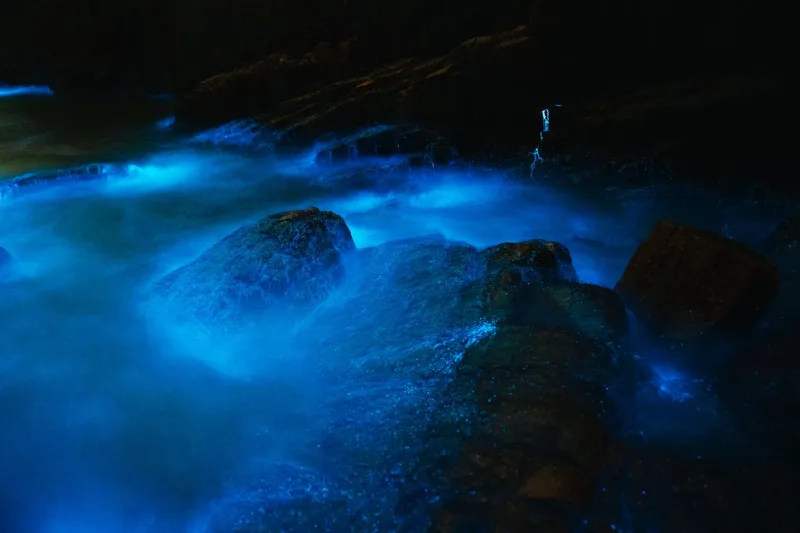
The glow there comes from microscopic dinoflagellates — single-celled organisms called Pyrodinium bahamense that light up when disturbed. Kayak through the bay on a moonless night and every paddle stroke leaves a trail of blue-white fire. Drag your hand through the water and it looks like you've got liquid neon running through your fingers.
The other two bays, Laguna Grande in Fajardo and La Parguera in Lajas, offer similar experiences with slightly different access logistics. Tour operators run nighttime kayak and boat excursions from all three locations, and the best conditions come during warm months when dinoflagellate populations peak. Pro tip from the hunting community: skip nights with a full moon. The ambient light washes out the effect.
Tennessee's Synchronous Fireflies: The Event That Sells Out Every Year
Every June, something remarkable happens in the Great Smoky Mountains. For roughly two weeks, a species of firefly called Photinus carolinus synchronizes its flashing patterns across entire hillsides — thousands of individual lights blinking in coordinated waves, like a natural light installation that covers acres of forest.
The Elkmont area of Great Smoky Mountains National Park is the epicenter of the action, and the National Park Service now runs a lottery system for parking passes because demand has simply gotten that intense. People fly in from across the country. Photographers set up rigs they've been planning for months. Families drive hours just to stand in the dark and watch bugs blink.
And honestly? It earns every bit of that hype. Seeing synchronous fireflies in full swing is one of those experiences that fundamentally changes how you think about what a light display can be. There's no programmer behind it, no artistic director. Just biology doing something extraordinary.
If you miss the Smokies lottery, the Allegheny National Forest in Pennsylvania and parts of the Ozarks also host synchronous firefly populations, with far less competition for a good viewing spot.
Foxfire: The Forest's Secret Glow
This one tends to surprise people. Certain species of bioluminescent fungi — collectively known as foxfire — cause decaying wood to emit a faint greenish glow in the dark. It's subtle, nothing like the electric blue of a dinoflagellate bay, but there's something almost otherworldly about finding a softly glowing log in the middle of a dark forest.
Foxfire has been documented across the eastern US, with sightings reported in the Appalachians, the Pacific Northwest, and parts of the Southeast. The hunting community treats it a bit like mushroom foraging — part science, part intuition, lots of tramping around in the woods at night with red-filtered flashlights (white light kills your night vision).
The best conditions are warm, humid nights following periods of rain. Look for older, decaying hardwood logs and stumps. Give your eyes at least 20 minutes to fully adjust to the darkness before you start scanning. And manage your expectations — foxfire is a slow burn, not a fireworks show. But the people who've seen it tend to describe it with a kind of reverence that's hard to fake.
The Gear, the Community, and the Culture
Bioluminescence hunting has developed its own informal culture and knowledge base, spread mostly through Reddit communities, dedicated Facebook groups, and a handful of well-followed Instagram accounts. Photographers share exposure settings and location tips. Beginners ask about timing windows. Regulars debate the merits of different kayak tour operators in Puerto Rico.
On the gear side, serious hunters tend to travel light: a camera capable of long exposures, a red-light headlamp, waterproof footwear, and — critically — a reliable moon phase app. Lunar cycles govern everything in this hobby. A full moon can render a bioluminescent bay nearly invisible, while a new moon on a clear night turns it into something almost hallucinatory.
There's also a strong conservation ethic running through the community. Bioluminescent bays are fragile ecosystems, and light pollution, chemical runoff, and boat traffic can all damage dinoflagellate populations. Many hunters are vocal advocates for protecting these sites, and some have gotten involved with local conservation organizations in Puerto Rico and Florida.
Why It Hits Different
Here's the thing about natural bioluminescence that even the most spectacular man-made light installation can't fully replicate: it's alive. It responds to you. Touch the water and it reacts. Walk through a firefly meadow and the lights shift around you. There's a feedback loop between you and the light source that no LED grid has ever quite managed to reproduce.
For a community built around the idea that light is a form of art — that the way things glow can be genuinely moving and meaningful — bioluminescence represents something foundational. It's the original illuminated experience, running on chemistry and evolution rather than electricity and design software.
And the people chasing it across America's bays, forests, and meadows? They've figured out something worth knowing: the most extraordinary light shows on earth have been running a lot longer than we have. You just have to know when and where to look.