The Sky Is the Canvas: Finding the Northern Lights Right Here in the Continental US
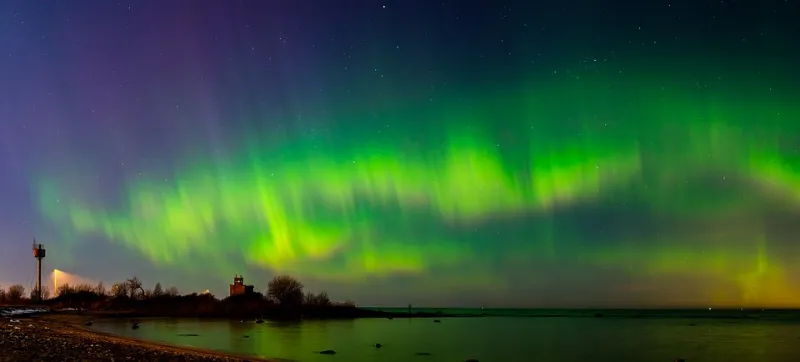
Photo: Maxim Bilovitskiy, CC BY 4.0, via Wikimedia Commons
There's a moment aurora chasers describe that sounds almost religious. You're standing in a field at 2 a.m., it's cold enough to see your breath, and then the sky just... opens up. Green ribbons start pulling themselves across the horizon, and suddenly the whole dark dome above you is doing something you can't quite explain to someone who hasn't seen it. It's not a light show in any manufactured sense — it's the atmosphere itself becoming art.
Here at Illums Online, we spend a lot of time celebrating the ways humans bend light into something extraordinary. But every now and then, nature one-ups all of us. And the good news? You don't have to book a flight to Iceland or blow your vacation budget on a Norwegian cruise to see it. The northern lights have been quietly performing across the continental United States for years — you just have to know where, and when, to look.
Why the Lower 48 Gets More Aurora Than You'd Think
Most people assume the aurora borealis is strictly a polar phenomenon, but the science tells a different story. The lights are triggered by solar wind — charged particles from the sun that interact with Earth's magnetic field and excite atmospheric gases into glowing. During periods of high solar activity, that interaction happens at much lower latitudes than usual.
Right now, we happen to be near the peak of Solar Cycle 25, which scientists have noted is tracking stronger than originally predicted. That means geomagnetic storms capable of pushing aurora visibility down into the northern tier of the US — and sometimes even further south — are happening with increasing frequency. The spring of 2024 saw widespread aurora sightings as far south as Texas and Florida, events that sent the internet into a collective frenzy and introduced millions of Americans to the idea that this was something they could actually witness from their own backyard.
For the serious watcher, though, chasing the lights is less about luck and more about positioning yourself correctly before the storm hits.
Michigan's Upper Peninsula: America's Aurora Heartland
If there's one region in the Lower 48 that aurora chasers return to again and again, it's Michigan's Upper Peninsula. Jutting up between Lake Superior and Lake Michigan, the UP sits at a latitude that puts it in the aurora zone during moderate geomagnetic events (KP index of 4 or higher), and its sparse population means genuinely dark skies are never far from the highway.
Picture Rocks National Lakeshore is a particular favorite. The sandstone cliffs drop straight into Lake Superior, and on a clear night with active solar wind, the lights reflect off the water below you in a way that doubles the entire display. It's immersive in a way that no indoor installation could replicate — the natural world functioning as its own infinite light installation.
 Photo: Picture Rocks National Lakeshore, via blogger.googleusercontent.com
The small town of Marquette has quietly become a hub for aurora tourism, with local outfitters offering guided night-sky excursions and a handful of lodges that will text you a wake-up alert if the KP index spikes overnight. Veteran chaser Dana Kowalski, who has logged over 200 aurora sightings from the UP since 2018, puts it simply: "People fly to Iceland and spend three grand hoping for one clear night. I drive four hours from Detroit and see the lights eight or ten times a year. The math isn't complicated."
Montana and Idaho: Big Sky, Bigger Lights
Out west, Montana earns its "Big Sky Country" nickname in ways that matter enormously for aurora viewing. The combination of high latitude, low light pollution, and consistently dry air through the fall and early winter makes the state one of the most reliable spots in the continental US for catching a display.
Glacier National Park is the crown jewel. The park sits at roughly the same latitude as the UP of Michigan but adds dramatic mountain backdrops that make even a modest aurora display feel cinematic. The Going-to-the-Sun Road corridor, while closed to vehicles in winter, is accessible on foot and snowshoe, and the rangers there have embraced dark sky programming in a big way.
 Photo: Glacier National Park, via papermoon24.de
Just across the border, northern Idaho — particularly the area around Sandpoint and the Selkirk Mountains — offers similarly dark skies with more accessible lodging options. The Selkirk Loop, a cross-border scenic route, draws aurora tourists from across the Pacific Northwest who treat it as their version of the Iceland ring road.
Minnesota's Arrowhead Region: Closer Than You Think
For anyone living in the Midwest, the Arrowhead region of northeastern Minnesota is the most accessible serious aurora-viewing destination in the country. The area around Grand Marais and the Boundary Waters Canoe Area Wilderness consistently ranks among the darkest places east of the Rockies, and its position along the north shore of Lake Superior gives it that same water-reflection magic as the UP.
 Photo: Boundary Waters Canoe Area Wilderness, via www.meme-arsenal.com
The town of Grand Marais has leaned hard into its identity as a dark sky destination, and the surrounding Cook County has taken steps to limit new light pollution. Several resorts in the area now actively market aurora packages, complete with hot tubs positioned for sky-watching and staff who monitor space weather forecasts so guests don't miss a thing.
How to Actually Plan a Trip Around the Lights
The single most important tool in any aurora chaser's kit is a reliable space weather app. NOAA's Space Weather Prediction Center (spaceweather.gov) is the gold standard, and apps like SpaceWeatherLive and My Aurora Forecast translate the raw data into plain-English alerts. The KP index — which runs from 0 to 9 — is your key metric. For most Lower 48 viewing locations, you want a KP of at least 4 to 5 for a reasonable show; KP 7 and above is when things get genuinely spectacular and visible much further south.
Timing matters beyond just solar activity. The equinoxes — late March and late September — are statistically the most active periods for geomagnetic storms due to the alignment of Earth's magnetic field with the solar wind. Clear, moonless nights are obviously ideal, and the hours between 10 p.m. and 2 a.m. local time tend to be the most active window.
Dress for temperatures that are colder than the forecast suggests — standing still in a dark field at midnight will make 40 degrees feel like 25. Bring a red-light headlamp to preserve your night vision, and if you're shooting photos, manual mode with a wide aperture, high ISO, and a shutter speed between 5 and 15 seconds is a solid starting point.
The Bigger Picture: Dark Sky Tourism Is Having a Moment
What's happening around aurora travel is part of a broader shift in how Americans think about nature-based experiences. The International Dark-Sky Association now certifies dark sky parks, reserves, and communities across the US, and that designation has become a genuine tourism driver. Places like Cherry Springs State Park in Pennsylvania and Natural Bridges National Monument in Utah have built real visitor economies around the simple act of looking up.
For those of us drawn to light as a medium — whether it's a neon installation, a projection-mapped building, or a stained glass window catching the afternoon sun — the aurora represents something humbling. It's the reminder that the most breathtaking light experience on the planet is one that no artist designed, no engineer optimized, and no algorithm served to you. You have to go find it yourself.
And it turns out, you don't have to go nearly as far as you thought.