The Office After Dark: What Happens When Your Workplace Finally Gets Its Lighting Right
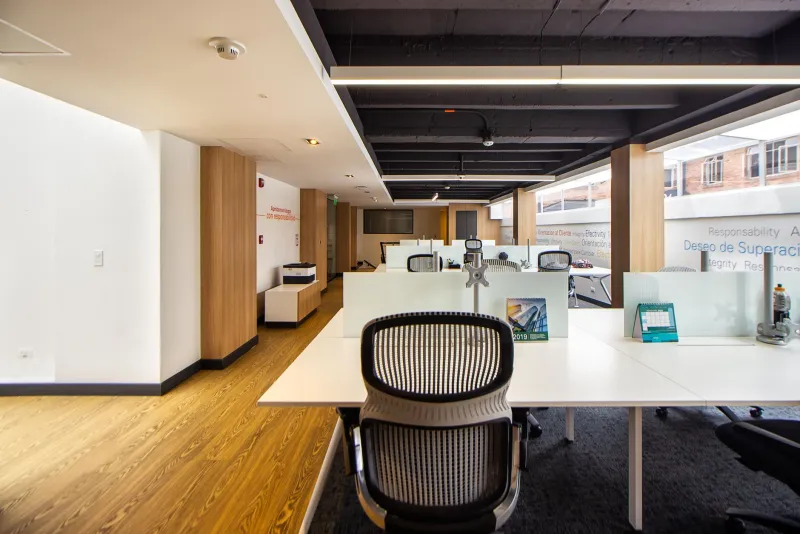
There's a moment most office workers know intimately — that mid-afternoon slump, somewhere around 2:30 p.m., when the overhead fluorescents seem to flatten everything including your will to exist. The light isn't dim, exactly. It's just relentless. Cool, flat, omnidirectional, and utterly indifferent to the fact that your body is running on a biological clock that has very specific opinions about what kind of light it wants to see at any given hour.
For most of the twentieth century, that indifference was the point. Fluorescent lighting was cheap, bright, and uniform — perfect for an era when office work meant processing paper under conditions optimized for visibility, not well-being. But something is shifting. Quietly, in office parks and corporate towers from Boston to Burbank, facilities managers are ripping out those humming grids and replacing them with LED systems that can change color temperature, intensity, and direction throughout the day. The fluorescent era, it turns out, may finally be ending.
The Biology You Can't Argue With
To understand why this matters, you need to understand a little about how light and the human body actually interact. The short version: your circadian rhythm — the internal clock that regulates sleep, alertness, hormone production, and metabolism — is primarily set by light. Specifically, by the color temperature and intensity of the light hitting your eyes at different times of day.
In natural conditions, morning light is bright and blue-shifted, signaling to your brain that it's time to be alert. As the day progresses, light warms and dims, preparing your body for rest. Your body produces cortisol in the morning and melatonin in the evening, and light is the primary trigger for both.
Traditional office fluorescents blast cool, blue-white light (typically around 4000K color temperature) at the same intensity from 8 a.m. to 6 p.m., regardless of what your biology is expecting. The result is a kind of lighting that's simultaneously overstimulating in the morning and insufficiently dynamic in the afternoon — a flat, artificial day that your circadian clock never quite accepts.
Dr. Lauren Hess, a researcher in environmental psychology at a university in Ann Arbor, has spent years studying how workplace lighting affects cognitive performance. "The evidence is pretty clear that light has direct and measurable effects on alertness, mood, and cognitive function," she says. "What's less clear is the degree to which optimizing workplace lighting translates into real productivity gains versus general well-being improvements. Both matter, but they're different claims."
From Fluorescent to Flexible
The technology enabling this shift is tunable LED lighting — systems that allow facilities managers (or even individual employees) to adjust color temperature and brightness throughout the day. A morning setting might run cool and bright, mimicking natural daylight and supporting alertness. Afternoon settings might warm slightly and reduce intensity. Evening settings, for late workers, might shift toward warmer tones that minimize circadian disruption.
Some systems go further, incorporating sensors that respond to occupancy, natural light levels, and even time-of-day schedules — automatically adjusting the entire office environment without anyone touching a control panel.
The cost of entry has dropped dramatically. A full LED retrofit for a mid-sized office floor that would have cost $150,000 five years ago might run $60,000 to $80,000 today, with energy savings that typically deliver a return on investment within three to five years. For larger organizations, the business case practically writes itself.
Greg Tanner is the facilities director for a regional insurance company in Columbus, Ohio, that completed a full LED retrofit across three floors of its headquarters last year. "Honestly, the energy cost reduction was what got it approved by the CFO," he says. "But the employee response has been the more interesting story. We've had people stop by my office just to tell me the new lighting makes them feel better. That doesn't happen when you replace the HVAC."
What Workers Actually Notice
Employee response to lighting upgrades tends to follow a predictable pattern: initial surprise, then gradual appreciation, then the kind of ambient satisfaction that's hard to articulate but easy to feel. Workers at companies that have made the switch consistently report feeling less fatigued, less prone to headaches, and — perhaps most tellingly — more willing to stay in the office rather than migrate to coffee shops or work from home.
Sarah Munoz, an account manager at a tech consultancy in Austin that installed a circadian-aligned LED system in 2022, describes the change as subtle but cumulative. "It's not like you walk in and think, 'Wow, incredible lighting.' It's more that you get to 4 p.m. and realize you don't feel like you've been hit by a truck. That's new."
Not everyone is a convert. Some workers find tunable lighting systems disorienting, particularly when color temperature shifts are too abrupt or too dramatic. Others are skeptical that the benefits justify the investment. "It's nice, I guess," says one financial analyst at a firm in Charlotte that recently completed a retrofit. "But I still feel exactly as tired on Monday morning as I did before. Maybe I just need a better job."
The Wellness Theater Problem
Dr. Hess raises a question that the facilities industry doesn't love to hear: how much of the reported benefit from office lighting upgrades is genuine physiological improvement, and how much is the Hawthorne effect — the well-documented tendency for workers to perform better simply because they feel their employer is paying attention to their experience?
"When a company invests visibly in employee well-being, workers notice. They feel valued. That feeling alone can improve morale, engagement, and retention," she explains. "The lighting might be doing real biological work, or it might primarily be a signal. Probably it's both, which is fine — but you should know which one you're buying."
This is the honest tension at the heart of the office lighting revolution. The science of circadian lighting is real and growing. The technology is genuinely impressive. But the gap between "this has measurable effects in controlled studies" and "this will transform your workforce productivity" is significant, and some vendors are not above bridging that gap with enthusiasm rather than evidence.
Tanner, the Columbus facilities director, is pragmatic about it. "I don't need a double-blind study to know that my employees prefer this environment. Retention is up. Complaints are down. If some of that is placebo, I'll take it."
The Design Opportunity Nobody's Talking About
What the office lighting conversation tends to miss is the aesthetic dimension. Beyond circadian science and energy efficiency, tunable LED systems give workplace designers a tool they've never had before: the ability to shape the visual and emotional character of a space across the entire arc of the workday.
A well-designed office lighting system can make a conference room feel energizing for a morning brainstorm and contemplative for an afternoon strategy session. It can make a collaborative lounge feel warm and social at noon and focused and quiet at 5 p.m. It can turn a generic open floor plan into a space that actually responds to human needs rather than simply illuminating them.
That's a design opportunity as significant as furniture or architecture — and it's one that most companies are only beginning to explore. The fluorescent era treated light as infrastructure. The LED era is starting to treat it as experience.
For the humans sitting under it eight hours a day, that distinction turns out to matter quite a lot.