The People Who Make You Feel the Music: Inside the Hidden World of Concert Lighting Design
The show starts in a parking lot in suburban New Jersey, six hours before anyone buys a beer or finds their seat. A semi-trailer is open at the dock, and a crew of twelve is moving road cases the size of refrigerators through a loading dock that smells like old concrete and stale coffee. Somewhere in the middle of that controlled chaos, a woman named Claire Holt is standing very still, staring at a ceiling rig, doing math in her head.
Holt is the lighting designer for a mid-sized arena tour that's currently in its fourth week of a 60-date run. She hasn't slept more than six hours in any single night since the tour kicked off. She's also, by most accounts in the industry, one of the most talented people working in live concert lighting right now.
"People think the show is the show," she says, not taking her eyes off the rig. "The show is actually this. Right now. Everything that happens tonight was decided in that load-in."
Light as Emotional Architecture
Concert lighting design is one of those disciplines that almost nobody outside the industry knows exists as a distinct craft — and yet it shapes how millions of Americans experience live music every single year. The lighting designer's job isn't just to make a stage look cool. It's to build an emotional journey that runs in parallel with the music, amplifying what the artist is communicating and guiding the audience through a series of feelings they may not even consciously register.
"I think of it as architecture," says Denver-based LD (industry shorthand for lighting designer) Sam Okafor, who has worked on tours for artists across country, hip-hop, and pop. "The music gives you the structure. My job is to build the rooms inside that structure — where the ceiling is high, where it's intimate, where you feel exposed, where you feel held."
The tools available to modern concert LDs are extraordinary. Automated moving head fixtures can pan, tilt, change color, and shift beam shape in fractions of a second. LED video walls have replaced traditional backdrops, allowing lighting and visual content to merge into a single unified surface. Haze and fog machines — the unsung heroes of concert lighting — make laser beams and light shafts visible in a way that turns the air itself into a medium.
But the technology is only as good as the intention behind it. And the intention, in the best concert lighting, is always emotional.
The Psychology Behind the Rig
Spend enough time talking to LDs and a few principles come up again and again. Contrast is everything: a moment of near-total darkness makes the light that follows feel like a physical event. Color temperature shapes mood in ways that bypass rational thought — warm ambers and golds feel human and nostalgic, while cold blues and whites create distance or urgency. The angle of light on a performer's face determines whether they look like a god or a ghost.
"There's a reason why a single follow spot on a solo performer in a dark arena makes people cry," Okafor explains. "It's isolation. It's vulnerability. You've taken this person who was surrounded by a band and a light show and a crowd of 20,000 people, and suddenly they're just... alone in the dark. That's a powerful thing to do to somebody."
The science backs this up. Research in environmental psychology has long established that lighting conditions influence emotional state, alertness, and even social behavior. Concert LDs are essentially applied psychologists, using that knowledge in real time in front of thousands of people.
Iconic Moments, Invisible Hands
Ask any LD about the shows that changed how they think about their work, and you'll get a list of moments that most concertgoers remember as purely musical experiences — but which were, in fact, lighting decisions.
The slow, single-color flood that holds through an entire bridge. The strobe burst that hits precisely on the snare crack. The moment the house lights come up during an audience singalong, and suddenly 15,000 people can see each other. These aren't accidents or afterthoughts. They're craft.
Holt points to a moment in her current tour — she's cagey about the artist, which is common in an industry built on NDAs — where a song's emotional climax is marked not by more light, but by less. "Everything pulls back to a single warm amber wash, very low intensity, and we hold it for eight bars. It's the quietest moment in the show visually. And it's the moment people lose it every single night."
That kind of counterintuitive thinking — using restraint when the instinct might be to go bigger — is what separates good concert lighting from great concert lighting.
The Road That Leads Here
There's no single path into concert lighting design, which is part of what makes the community so eclectic. Some LDs come up through theater programs, where they learn the foundational language of stage light. Others start as electricians on touring crews and work their way into programming roles. A growing number are coming from the visual art and installation world, bringing a more conceptual sensibility to a field that has traditionally been more technically focused.
"The line between what I do and what a light installation artist does is getting blurry," says Holt. "I've had conversations with people who show work in galleries and festivals, and we're basically talking about the same problems — how do you use light to make someone feel something they didn't expect to feel?"
That cross-pollination is producing some of the most visually ambitious concert production in recent memory. Festivals like Coachella and Lollapalooza have become showcases for lighting work that's genuinely indistinguishable from fine art installation, and the audience for that kind of work — people who go to concerts partly for the visual experience — is growing fast.
What the Next Generation Is Building
For young designers entering the field, the moment is genuinely exciting. The tools are more powerful and more accessible than ever. The audience is more visually literate, more likely to notice and respond to sophisticated lighting work. And the boundaries between concert production, immersive experience design, and light art are dissolving in ways that open up entirely new possibilities.
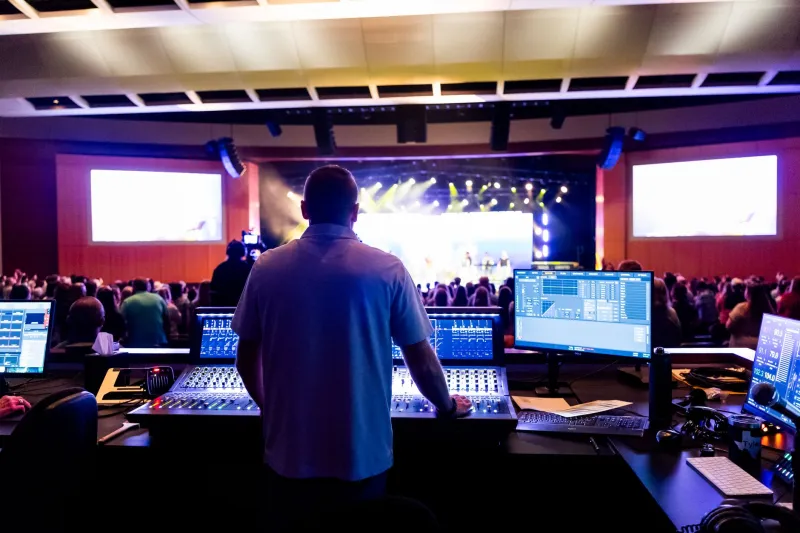
Back in New Jersey, Holt is finally satisfied with the rig. The math worked out. Showtime is four hours away. She'll spend most of that time in front of a console the size of a kitchen counter, running through cues, adjusting timing, making tiny decisions that the audience will never consciously notice but will absolutely feel.
That's the job. That's the whole job. And she wouldn't trade it for anything.