Plugged In and Lit Up: How Personal Computers Became the Unexpected Canvas of the Light Art World
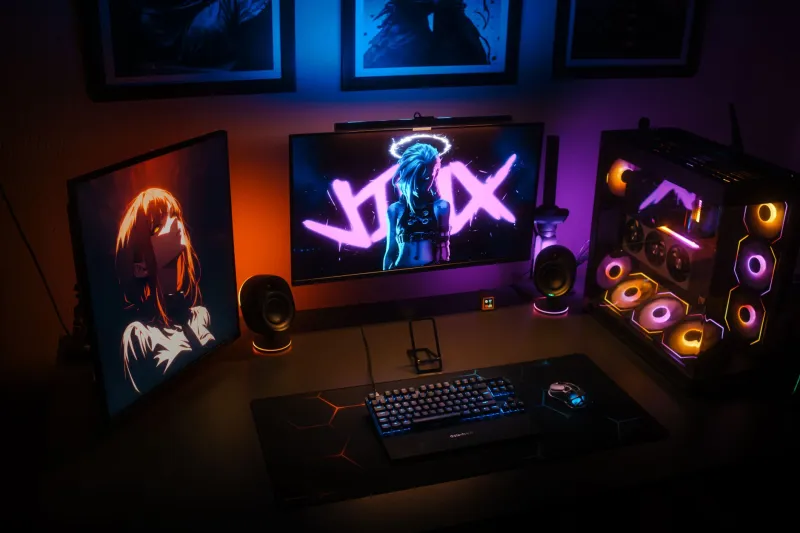
There's a moment, usually somewhere around midnight, when the rest of the house goes dark and the only thing glowing is the machine on your desk. For a lot of Americans, that glow is purely functional — a screen, a keyboard, a task. But for a growing community of builders, designers, and flat-out enthusiasts, the personal computer has become something else entirely: a light art installation you happen to use to browse the internet.
It sounds a little dramatic until you actually see one of these builds in person. We're talking tempered glass side panels backlit by synchronized LED strips, CPU coolers that pulse like slow-breathing organisms, cables braided and routed with the kind of care a jeweler gives to a setting. These aren't just computers. They're illuminated objects — and the people making them are thinking about light in ways that would feel right at home in any serious design conversation.
The RGB Revolution Nobody Saw Coming
A decade ago, the idea of a glowing computer was mostly associated with teenager bedrooms and a certain flavor of over-the-top gamer aesthetic. Red LEDs, maybe some green. Nothing particularly considered. Then something shifted.
Manufacturers started taking RGB lighting seriously — not just as a gimmick but as a genuine design feature. Software caught up, giving builders granular control over every light source in their system. And a generation of builders who grew up watching YouTube teardowns and custom build videos started asking a different question: not just does it run, but does it look right.
Now the PC building community in the US is enormous, deeply online, and surprisingly thoughtful about aesthetics. Subreddits dedicated to custom builds have millions of members. Hardware stores carry components specifically designed to be seen — frosted reservoirs for liquid cooling loops, addressable LED fans that can display animations, motherboards with illuminated accents along their edges.
The light isn't incidental anymore. For a lot of builders, it's the whole point.
Light as Personal Expression
What's genuinely interesting about PC lighting culture — and what connects it to the broader world of illuminated art and design — is how personal it gets. Walk into any custom build showcase online and you'll find wildly different approaches to the same basic palette.
Some builders go monochromatic: a single color, usually white or a deep blue, held perfectly consistent across every component. The effect is almost architectural — clean, deliberate, like a room designed around a single light source. Others go full spectrum, using software to cycle through colors or sync the lighting to music, turning the machine into something closer to a reactive light sculpture.
Then there are the themed builds — the ones where someone has committed fully to a concept. Machines built to look like they belong in a 1980s sci-fi film. Builds that reference a specific game world or aesthetic. One builder in Portland spent eight months constructing a case designed to look like a glowing terrarium, complete with custom-fabricated acrylic panels etched with botanical patterns that light up from behind.
These aren't mass-produced products. They're one-of-a-kind objects, and the light is inseparable from what makes them what they are.
The Craft Behind the Glow
Building a visually compelling PC is harder than it looks, and the lighting is often the hardest part to get right. It's not enough to just install RGB components and call it done. You have to think about diffusion — whether the light is harsh and direct or softened by a frosted panel. You have to think about color temperature and how different light sources interact when they're all on at the same time. You have to think about negative space, about what stays dark and why.
That's design thinking. Real design thinking, applied to a consumer electronics object.
Some builders have backgrounds in photography or architecture. Others are self-taught, learning by doing and by obsessively studying other people's work. What they share is a willingness to treat the personal computer as more than a tool — as an artifact that lives in a space and contributes to the visual character of that space.
Lighting software has become a design tool in its own right. Programs like Corsair's iCUE or ASUS's Aura Sync let builders create layered lighting profiles, animate effects, and sync multiple components so they behave as a single coherent light source. It's not unlike the kind of control a stage lighting designer has over a theatrical rig — granular, intentional, expressive.
From Desk to Display
For some builders, the personal computer has moved beyond the desk entirely. Custom builds are showing up in retail environments, in restaurants, in art galleries. There are builders who take commissions from businesses that want a visually striking machine as part of their interior design — not necessarily to use intensively, but to see.
That's a meaningful shift. It says something about how far the culture has come that a personal computer can be considered décor, can be considered art, can be the thing in the room that everyone gravitates toward because of the way it glows.
At the same time, the community is careful not to lose what makes it special: the DIY spirit, the obsessive attention to detail, the sense that anyone with enough patience and curiosity can build something genuinely beautiful. Big manufacturers have noticed the trend and started selling pre-built systems with elaborate lighting, but most serious builders will tell you that's not really the point. The point is the process — the hours spent planning a cable route, testing a color profile, adjusting a fan angle so the light catches differently.
Why It Matters
It would be easy to dismiss PC lighting culture as a niche hobby, a slightly nerdy corner of the internet where people argue about the best way to hide their cables. And sure, it's that too. But it's also a genuine popular art form — one that's accessible, democratic, and deeply tied to how Americans are living with light right now.
The personal computer sits at the center of most people's lives. It's where we work, where we play, where we create. The fact that so many people are choosing to make that object beautiful — to think carefully about the light it puts into a room — says something real about how we relate to our environments and the things we spend our time with.
Light has always been personal. The personal computer just made it more so.