Dead Malls, Living Light: The Artists Turning Retail Ruins Into Glowing Cathedrals
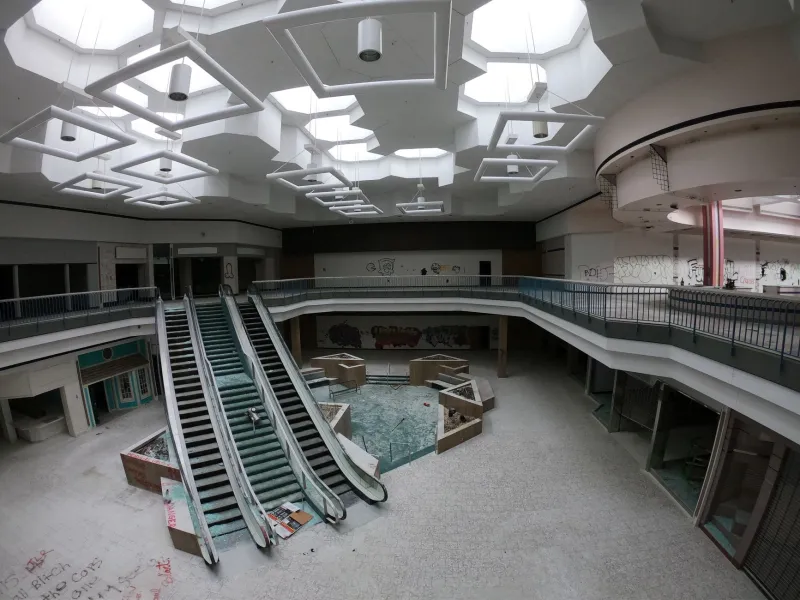
There's a particular kind of quiet inside a dead mall. Not peaceful quiet — more like the silence a building makes when it's still confused about what it's supposed to be. The food court chairs are still bolted to the floor. The directory map still points to a Sears that closed four years ago. And the skylights — those long, arched skylights that mall architects loved so much in the 1980s — still pour a pale, dusty light down through the atrium like the building is trying, against all odds, to remember when it mattered.
That light is exactly why artists keep showing up.
The Ruin Has Good Bones
It sounds counterintuitive at first. Why would serious light artists — people who have shown work in galleries, museums, and festival circuits — want to drag equipment into a crumbling JCPenney anchor space in suburban Ohio or a half-gutted mall corridor in Stockton, California? The answer, once you hear it, makes a lot of sense.
"The scale is insane," says Marcus Devlin, a Chicago-based installation artist who has staged three unauthorized — and one fully permitted — light works inside defunct malls over the past five years. "You're talking about 50-foot ceilings, uninterrupted floor plates the size of football fields, and surfaces that already have this beautiful decay texture built into them. You couldn't design a better canvas if you tried."
Devlin's most talked-about piece, a 2022 installation called Anchor, filled the former Sears wing of a shuttered Illinois mall with slowly pulsing amber and blue light projected across peeling ceiling tiles and abandoned escalators. Photos of the work circulated widely on social media — partly because it was gorgeous, and partly because nobody was entirely sure if it was legal.
That ambiguity is kind of the point.
The Legal Gray Zone (and Why Artists Keep Wading Into It)
Let's be honest about the landscape here. Some of these projects happen with full permission from property owners — and those deals are becoming more common as mall owners realize that an Instagram-famous light show is better PR than a "For Lease" sign. But a significant number of mall light installations exist in murkier territory: artists who've gotten informal verbal permission from a security guard, collectives who've simply found a way in and moved fast, or crews who've built relationships with sympathetic property managers who look the other way.
Jordan Reyes, a Detroit-based artist and co-founder of the collective Luminal Ground, describes the negotiation process as "part art project, part real estate pitch."
"We've cold-called property management companies, shown up at city council meetings, even gone through the lawyers for a REIT that owned a mall in Michigan," Reyes says. "Sometimes they say yes because they genuinely want something cool to happen. Sometimes they say yes because they just want someone in the building so copper thieves don't strip the wiring. Either way, we get to make the work."
The legal risks are real. Trespassing charges, liability exposure, equipment seizure — artists working without formal agreements take on genuine risk. But the counterargument, which many in this community make passionately, is that these buildings are already dying. Nobody's protecting them. The art, in a way, is the last thing keeping them alive.
Why These Spaces Hit Different
There's a psychological dimension to the dead mall that no other venue quite replicates. These places carry collective American memory. Entire generations had their first jobs here, their first dates, their first sense of a world beyond their neighborhood. Walking back into one — especially when it's been transformed by light — triggers something complicated and emotional.
That's not an accident. Many of the artists working in these spaces are deliberately engaging with that nostalgia, using light to interrogate what these buildings meant and what their collapse says about American consumer culture.
San Francisco-based designer Priya Nakamura created a piece for a vacant Sacramento mall that used warm incandescent-toned lighting to recreate the exact ambiance of a 1994 mall interior — the slightly yellowish glow of halogen display cases, the neon tube accents above store facades — before slowly transitioning the entire space to cold, clinical white. "I wanted people to feel the warmth first and then feel it taken away," she explains. "That's basically the story of these places."
The reaction at the one-night public event was, by multiple accounts, visceral. People cried. A lot.
The Technical Nightmare (and Why Artists Love It Anyway)
Working in abandoned malls isn't just emotionally complicated — it's technically brutal. Power infrastructure is unreliable or nonexistent, which means artists often run their own generators or negotiate access to whatever electrical systems remain functional. Ceilings that look solid may not be. HVAC systems that haven't run in years create unpredictable temperature swings that affect projectors and sensitive LED equipment.
"You do a site visit, you think you understand the space, and then you show up with your gear and discover that half the ceiling has water damage and your projection surface is basically papier-mâché," says Devlin. "You adapt. You find the wall that still works. Sometimes the damage becomes part of the piece."
That improvisational quality — the willingness to let the building talk back — is part of what makes mall light art feel different from more controlled gallery environments. These aren't pristine white-cube installations. They're collaborations between the artist and a structure that's actively falling apart.
Where This Is Heading
The trend is accelerating, and not just in the underground art world. Several cities have started formally partnering with artists and collectives to activate dead malls as temporary cultural venues before demolition or redevelopment. Pittsburgh, Detroit, and Tucson have all seen some version of this in recent years, with local arts organizations brokering agreements that give artists access in exchange for public programming.
There's also growing interest from the festival circuit. At least two prominent immersive art festivals have begun scouting dead malls as potential venues, drawn by the same things individual artists love: the scale, the atmosphere, the built-in emotional weight.
For the artists themselves, the appeal goes beyond any single project. The dead mall represents something specific about American ambition and American failure — about what we built, what we abandoned, and what we might still make of the wreckage. Light, with its ability to simultaneously reveal and transform, turns out to be exactly the right medium for that conversation.
The malls are empty. The skylights are still there. And the artists keep showing up with their gear, ready to make something glow.