Washed Out: What America's Light Pollution Crisis Is Doing to Photographers — and How They're Fighting Back
There's a photograph that circulates periodically on astronomy forums and photography communities, usually captioned with something like "what we've lost." It shows two images of the same Los Angeles skyline taken roughly 60 years apart. In the older image, the Milky Way arches clearly above the city, a dense river of stars visible even from an urban rooftop. In the newer one, the sky is a flat, featureless orange-brown. The stars are gone. The city ate them.
It's a stark illustration of a problem that's been building for decades and is now impossible to ignore: light pollution has fundamentally changed the American night, and the visual artists, photographers, and astrophotographers who depend on darkness are navigating a landscape that's getting harder to work in every year.
The Scale of the Problem
According to research published in the journal Science Advances, roughly 99% of Americans live under light-polluted skies. More than a third of the country's population — and 60% of Europeans — can no longer see the Milky Way from where they live. The brightening of the night sky is accelerating, with artificial light increasing at roughly 10% per year in some regions.
The culprits are familiar: streetlights, commercial signage, sports facilities, parking lots, and the general sprawl of development that pushes artificial light further into previously dark areas. The widespread adoption of LED lighting — more energy-efficient, yes, but also capable of emitting more blue-spectrum light that scatters more aggressively in the atmosphere — has in some cases made skyglow worse even as individual fixtures became more efficient.
For astrophotographers, the effects are direct and measurable. Images that once required an hour of exposure now need multiple hours of stacking to achieve the same signal-to-noise ratio. Narrowband filters that isolate specific wavelengths of starlight have become essential gear for anyone shooting near a city. And the distances photographers must travel to find genuinely dark skies keep growing.
"Ten years ago I could get usable dark sky about 90 minutes outside of Atlanta," says astrophotographer Kwame Asante, who has been shooting the night sky for 15 years. "Now I'm driving three, sometimes four hours. The bubble keeps expanding."
What's Being Lost, Artistically
The impact isn't purely technical. There's an aesthetic loss that's harder to quantify but just as real.
The night sky has been a subject of human art for as long as humans have made art. Van Gogh's Starry Night is the obvious reference, but the influence runs deeper — through centuries of landscape painting, through the sublime tradition in American art, through the photography of Ansel Adams and his successors who understood darkness as a compositional element as powerful as any mountain or waterfall.
That tradition depends on access to actual darkness. And as that access shrinks, the visual vocabulary built around it starts to narrow.
"There's a whole register of human experience that's tied to the night sky," says Dr. Sarah Kline, an art historian at the University of Colorado who studies environmental influences on visual culture. "Awe, smallness, the sense of being part of something vast. When you can't see the sky, you lose the visual trigger for those feelings. That's not a small thing."
For photographers who specialize in night landscapes, the emotional weight of that loss is personal. Many describe a kind of grief — watching places they've photographed for years gradually brighten, watching images they made a decade ago become impossible to recreate from the same location.
The Creative Response
Here's where the story gets more interesting. Because a significant number of visual artists aren't just mourning what's been lost — they're making work about the loss itself, and some of that work is genuinely striking.
Photographer and installation artist Mara Dunning, based in New Mexico, has spent the last five years documenting light pollution not as a problem to be solved but as a subject to be examined. Her ongoing series Skyglow photographs American cities from above at night, capturing the orange domes of light that bloom over population centers. The images are beautiful in a troubling way — massive, luminous, almost geological in their scale. They look like natural phenomena. They are not.
"I wanted people to see what this looks like from the outside," Dunning says. "When you're inside a city, you don't see the glow. You just see the city. But from above, you see what it's doing to everything around it. It's overwhelming."
Other artists are working in a different direction — not documenting the pollution but using it as raw material. Painter and mixed-media artist Deon Castillo, who works out of Phoenix, has developed a practice built around what he calls "polluted sky studies" — long-exposure photographs of heavily light-polluted skies that capture the strange, layered colors produced by different types of artificial light interacting with atmospheric particles. Sodium vapor orange. LED blue-white. Neon pink. The resulting images look like abstract paintings, which is exactly how Castillo uses them — as source material for large-scale canvas work that celebrates the unintended color palette of the over-illuminated city.
"I'm not saying light pollution is good," he's careful to note. "I'm saying there's something real there to look at. Ignoring it doesn't help anyone."
The Technical Workarounds
For photographers who still want to shoot the night sky rather than the light pollution itself, adaptation has become a way of life. The gear has evolved accordingly.
Light pollution filters — specifically narrowband filters that isolate hydrogen-alpha and oxygen-III wavelengths — allow astrophotographers to cut through skyglow and capture nebulae and star-forming regions even from suburban locations. Modified cameras with enhanced infrared and hydrogen-alpha sensitivity have become more common. Software stacking techniques that combine dozens or hundreds of individual exposures have democratized a level of image quality that once required professional observatory equipment.
Community has also become a resource. Organizations like the International Dark-Sky Association maintain maps of certified Dark Sky Places — parks, preserves, and communities that have adopted lighting ordinances specifically to protect night sky access. For photographers willing to plan ahead and drive, these locations represent some of the last genuinely dark skies in the continental US.
"The community around dark sky photography is incredibly tight-knit," says Kwame Asante. "We share locations, we share techniques, we advocate together for better lighting policy. The problem has made us more connected, weirdly."
Advocacy Through the Lens
Perhaps the most powerful creative response to light pollution is also the most direct: using photography as advocacy. Images of star-filled skies — particularly those showing what's still possible in protected dark sky areas — have become some of the most effective tools in the conservation community's arsenal.
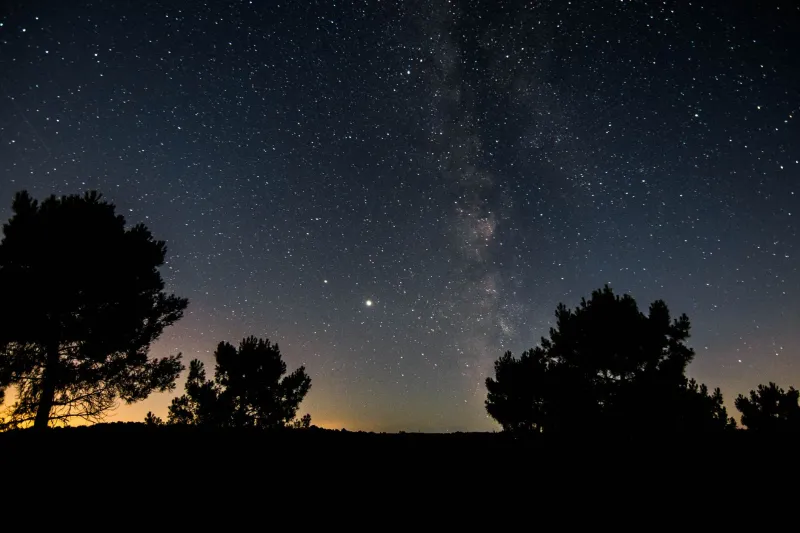
Photographs can do something scientific data struggles to: they make people feel what's at stake. An image of the Milky Way reflected in a still lake in rural Idaho communicates the value of dark skies in a way that lumens-per-square-meter measurements cannot.
"I've had people tell me my images made them write to their city council about streetlight ordinances," says astrophotographer and dark sky advocate Jonelle Park, whose work has appeared in national conservation campaigns. "That's the most useful thing my photography has ever done."
The night sky is still out there. Darker than your city, farther than you'd like, harder to reach than it used to be — but still there, still astonishing, still worth the drive. And the artists working to document, interpret, and protect it are doing some of the most urgent visual work in America right now.
Sometimes the most powerful light is the kind you have to fight to preserve.