When the Sky Cracks Open: Inside the World of Lightning Photography
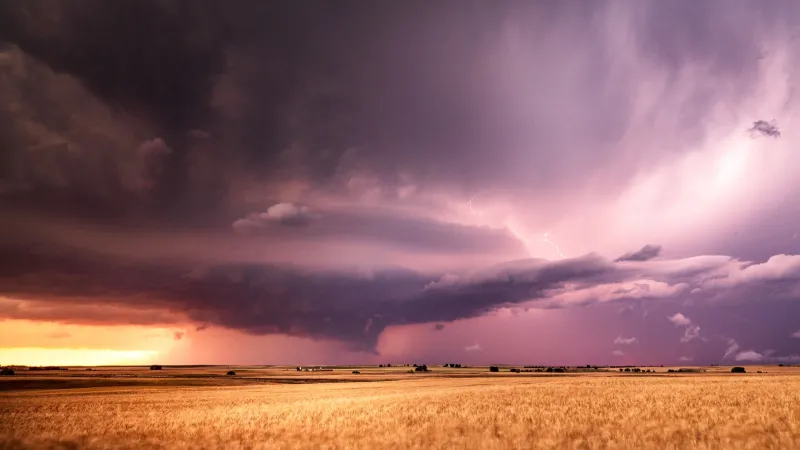
Somewhere on a dirt road outside Amarillo, Texas, a woman named Dana Rhoades is standing next to her pickup truck at 11:30 p.m., a tripod planted in the cracked earth, watching a supercell the size of a small city roll in from the west. She's not a meteorologist. She's not a storm chaser in the traditional sense — no Doppler radar subscriptions, no university grant money, no scientific instruments in the cab. What she does have is a Canon R5, a remote shutter trigger, and an almost irrational obsession with capturing lightning on her own terms.
"People think I'm out here collecting data," she says, laughing a little. "I'm out here collecting light."
Rhoades is part of a loosely connected, deeply passionate community of photographers scattered across the American interior who have turned storm chasing into something closer to a fine art practice than an extreme sport. They post in private Facebook groups, share Lightroom presets, debate shutter speeds at midnight over bad gas station coffee, and occasionally sell prints that hang in galleries from Denver to Nashville. The thing that unites them isn't meteorology — it's an almost devotional relationship with one of the planet's most unpredictable, most spectacular natural light events.
The Physics of a Perfect Strike
Let's talk about what lightning actually is for a second, because understanding the light helps you understand the obsession. A single bolt can reach temperatures around 30,000 Kelvin — roughly five times hotter than the surface of the sun. It lasts a fraction of a second. It produces a spectrum of light that ranges from deep violet through white to a warm orange fringe, depending on atmospheric moisture, distance, and the angle of your lens. It is, in the language of illuminated art, absolutely extraordinary source material.
The challenge, of course, is that you can't schedule it. You can't reposition it. You can't ask it to hold still. What you can do — what the best lightning photographers have learned to do — is read the sky well enough to put yourself in the right place, set your camera to capture long exposures or use a dedicated lightning trigger, and then get out of the way and let the storm do what it wants.
Mike Olbinski, a Phoenix-based photographer who has been chasing storms across the Great Plains for over a decade, describes his process as "controlled surrender." His time-lapse and still work has earned him a following in the hundreds of thousands online, and his prints have sold to collectors across the country. "You do everything you can to be technically prepared," he explains. "And then the storm decides what the image looks like. There's a humility in that I find really beautiful."
Gear, Grit, and the Long Wait
The gear setups in this community range from stripped-down minimalist to borderline obsessive. Most serious practitioners rely on full-frame mirrorless or DSLR systems paired with wide-angle lenses — the goal is capturing as much sky as possible, since you rarely know exactly where the next bolt will touch down. Many use dedicated lightning triggers like the MIOPS Smart+ or the Vello FreeWave, devices that detect the sudden spike in light and fire the shutter faster than any human reflex could manage.
Beyond the camera body, the logistics get complicated fast. You need a vehicle you trust on unpaved roads. You need weather apps — most serious chasers run multiple simultaneously, cross-referencing SPC outlooks with local radar loops. You need snacks, water, and the ability to sit absolutely still for two hours waiting for a storm to organize itself into something worth shooting. And you need a very clear exit strategy, because the same storm that gives you the most beautiful image of your life can pivot and put you in genuine danger within minutes.
"The danger is real, and I never want to minimize it," says Rhoades. "I've had bolts hit within a quarter mile. You feel it in your chest before you hear it. That's your reminder that this isn't a set piece — it's a living thing."
From Raw File to Gallery Wall
The post-processing conversation in lightning photography communities is almost as intense as the chasing itself. There's a philosophical fault line between those who treat their captures as documentary images — minimal editing, let the raw data speak — and those who approach the work as straight-up visual art, layering exposures, adjusting color temperature, compositing multiple strikes into a single frame.
That last technique is where the ethical debates get spicy. Compositing — combining several individual lightning bolts photographed over the course of a single storm into one image — is standard practice in many corners of the community. Proponents argue it reflects the cumulative visual experience of watching a storm move through, the way a painting might compress time into a single canvas. Critics call it deceptive, especially when images are sold without disclosure.
"I composite, and I'm open about it," says Dallas-based photographer Jerome Casteel, whose work has appeared in regional gallery shows and on the cover of a major outdoor lifestyle magazine. "Every bolt in my images is real, from that storm, that night. I'm just editing time, not reality. But I always tell buyers exactly what they're looking at."
The transparency question matters more as lightning photography migrates further into the fine art market. Collectors who pay four figures for a print have a reasonable interest in knowing what they're buying. And as more of these images circulate on social media stripped of context, the community is increasingly wrestling with how to handle attribution, disclosure, and the difference between artistic expression and misrepresentation.
The Midwest as Studio
Geographically, this art form belongs to the American interior. Tornado Alley — the broad swath of flatland running from Texas through Oklahoma, Kansas, Nebraska, and into South Dakota — offers the most reliably dramatic storm activity in the world. The combination of Gulf moisture, dry continental air, and vast open skies creates conditions that photographers describe, without irony, as a natural studio.
But the community has spread well beyond the classic chasing corridor. Florida, which logs more lightning strikes per square mile than any other state, has its own dedicated group of storm photographers working the afternoon thunderstorm cycle along the Gulf Coast. The Rockies produce spectacular isolated cell activity in late summer. Even the Northeast, not traditionally associated with extreme weather photography, has its devotees working the nor'easter season.
What all these places share is the same essential quality: a sky big enough to hold something extraordinary.
Light You Can't Buy, Only Chase
There's a reason lightning photography keeps pulling people back despite the danger, the expense, the long nights, and the missed shots. It offers something that no studio, no installation, no light art gallery can fully replicate — the specific thrill of a light source that is entirely indifferent to you. The storm doesn't perform for the camera. It doesn't care about your composition or your ISO settings or your gallery deadline. It just does what it does, and if you're lucky and prepared and a little bit brave, you get to bring some of it home.
Dana Rhoades, back on that dirt road outside Amarillo, pulls up an image on her phone from the previous night's chase. A single bolt, thick and branching, splits the frame from upper left to lower right against a sky that's cycling through indigo and electric green. It looks like a painting. It looks like something that shouldn't exist.
"That's what I came for," she says, and puts the phone away as the next cell starts to light up the western horizon.