Skin Deep, Light Bright: Inside the Underground World of UV Tattoo Artists
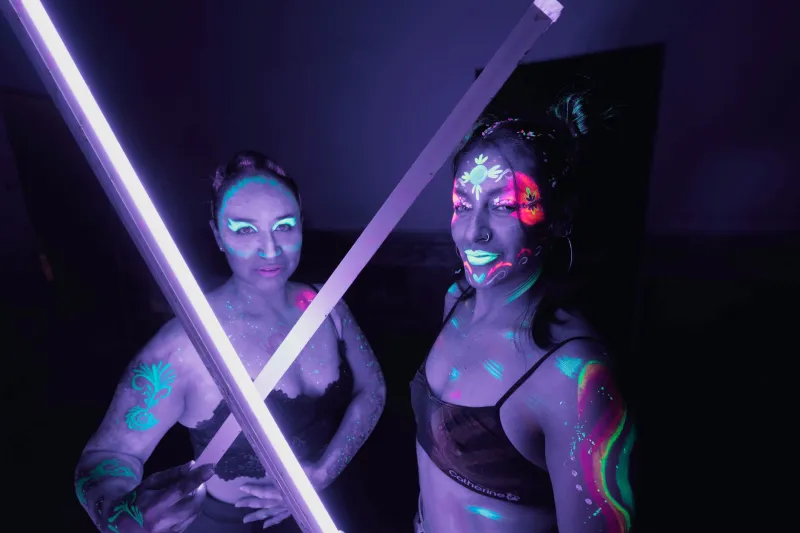
There's a moment that every UV tattoo collector describes almost the same way. You're at a festival, or a club, or maybe just a house party with a blacklight in the corner — and someone catches a glimpse of your arm. Their eyes go wide. They grab your wrist. What is that?
That reaction is basically the whole point.
UV-reactive tattooing — sometimes called blacklight tattooing, sometimes just called UV work — occupies a strange, glittering corner of the body art world. The designs are built with ink that contains phosphorescent compounds, rendering them nearly invisible under normal daylight and explosively vivid the moment ultraviolet light hits the skin. It's a medium that sits right at the intersection of body art and light art, and the community around it is small, deeply passionate, and growing faster than most people realize.
The Ink That Hides in Plain Sight
Working with UV ink is not like working with standard tattoo pigment. Ask any artist who specializes in it and they'll tell you the same thing: it's humbling.
"Regular ink is forgiving," says a Portland-based tattoo artist who goes by the name Solenne and has been doing UV work for about six years. "You can see exactly what you're laying down. With UV ink, you're essentially tattooing blind. You can't see the true result until you pull out a blacklight, and by then the skin is already traumatized. There's no going back."
The technical challenges stack up quickly. UV inks tend to be thinner in consistency than conventional pigments, which makes them harder to pack densely into the skin. Healed results can be unpredictable — what looks crisp on day one sometimes fades or blurs unevenly over weeks. And because the ink is translucent under natural light, any mistake is effectively invisible until it's illuminated, meaning artists have to develop an almost intuitive sense of the work as they go.
There's also the question of skin tone. UV ink performs differently across different complexions — on very fair skin, some UV pigments leave a faint visible trace even in daylight, which some collectors actually want. On deeper skin tones, the reactive compounds can still fire brilliantly under blacklight, but require a more experienced hand to ensure the saturation is right. Good UV artists know their medium the way a cinematographer knows light — not just what it does, but what it does on a specific surface.
The Artists Building a Practice Around the Glow
Across the US, a loose network of artists has quietly built reputations around UV work. Some do it exclusively; others fold it into a broader practice, offering UV elements as add-ons to traditional pieces — a constellation that glows, a floral pattern with hidden geometry, a portrait where the eyes suddenly ignite under a blacklight.
In Austin, an artist named Marco has developed a following among the city's festival crowd for his geometric UV overlays — intricate sacred geometry patterns that sit almost invisibly atop conventional black tattoos, revealing a second layer of meaning when the lights go low. "I think of it like a secret," he says. "The person wearing it knows it's there. The rest of the world only gets to see it in the right conditions."
In Chicago, a studio called Spectrum Ink has gone all-in on full UV compositions — pieces with no conventional ink at all, just reactive pigment across the skin. Owner and lead artist Deja describes her clientele as "people who think about their bodies the way curators think about gallery walls. They're not just getting a tattoo. They're installing something."
That framing resonates. The collectors who seek out UV work tend to be deeply intentional about it. These aren't impulse decisions. People research artists for months, travel across state lines, and think carefully about placement and design in ways that go well beyond the typical tattoo consultation.
The Festival Circuit and the Nightlife Scene
If there's one environment where UV tattoo culture fully comes alive, it's the American festival scene. Events like Electric Forest in Michigan, Imagine Music Festival in Georgia, or any number of regional rave and art gatherings have become informal galleries for UV body art. Under the blacklights and LED rigs that define these spaces, tattoo collectors become walking installations — their skin suddenly part of the visual landscape.
"At a festival, you stop being just a person," says one collector, a graphic designer from Denver named Priya who has UV work covering her forearms and collarbones. "You become part of the light show. People come up to you. You have conversations you'd never have otherwise. It's genuinely communal in a way I didn't expect."
Nightlife venues have picked up on this too. Blacklight nights and UV-themed events at clubs in cities like Miami, New York, and LA have created recurring contexts where UV tattoo art gets its moment. Some venues have even begun featuring tattoo artists at pop-up booths during events, offering small UV flash pieces on the spot — a direct fusion of nightlife culture and live art-making.
The Safety Conversation Nobody Wants to Skip
It would be dishonest to write about UV tattooing without acknowledging that the ink itself has a complicated history. Early UV tattoo pigments — particularly those used in the 1990s and early 2000s — were associated with allergic reactions, scarring, and inconsistent healing. Some of those early formulas contained compounds that simply weren't designed for dermal use.
The landscape has shifted considerably. Modern UV inks from reputable manufacturers are formulated specifically for tattooing, and many artists in the space are meticulous about sourcing. But the regulatory environment around tattoo ink in the US is still patchwork at best, and UV pigments aren't universally tested to the same standards as conventional colors.
Responsible artists are upfront about this. "I tell every client the same thing," says Solenne. "We know more than we did twenty years ago. The inks I use are the best available right now. But 'best available right now' isn't the same as 'perfectly understood forever.' You should know that going in."
Most serious UV collectors seem to have done their homework and made peace with that uncertainty — the same calculus that anyone getting tattooed makes, just with a slightly different set of variables.
The Body as the Most Personal Canvas
What makes UV tattooing feel like more than just a trend — more than a party trick — is what it says about the relationship between light and identity. Every other form of illuminated art exists on a wall, a screen, a building facade, a stretch of desert at a temporary festival. UV tattoos exist on a person. They move when the person moves. They age when the person ages. They go everywhere the person goes, invisible most of the time, waiting for the right light.
There's something genuinely poetic about that. The idea that you can carry a light installation on your body — that your skin can become the site of something that only reveals itself under specific conditions — touches on ideas about hidden identity, about the parts of ourselves we only show in certain contexts, about the way meaning can be layered and conditional and private.
Or maybe it's simpler than that. Maybe it's just about the look on someone's face when the blacklight hits and they see it for the first time.
That reaction. Those wide eyes. What is that?
That's the whole point.