After Hours, After Dark: The Projection Artists Painting American Cities With Light
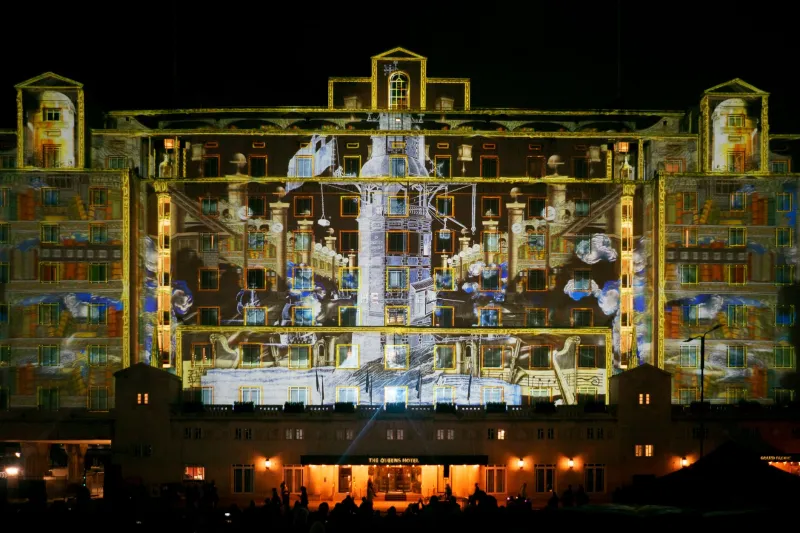
The wall is just a wall at 9 p.m. Brick, maybe. Or concrete. A little graffiti, a few years of grime, the usual story. Then a van pulls up, a tripod goes down, and somewhere around 9:47 p.m. the whole thing erupts into color.
That's the thing about projection mapping. It doesn't ask permission from the building. It just shows up and makes it beautiful.
Across the country — in Chicago's West Loop, under Austin's Congress Avenue Bridge, along Portland's waterfront — a loose, passionate community of projection artists is quietly rewriting what public art can be. They work after dark, often without permits, sometimes with official city blessing, always with an almost reckless belief that light itself is enough of a medium to say something real.
What Projection Mapping Actually Is (And Why It's Harder Than It Looks)
Strip away the spectacle for a second and projection mapping is, at its core, a technical problem. You're taking a flat or irregular surface — a building facade, a bridge arch, a curved sculpture — and using software to warp and align digital imagery so it appears to conform perfectly to the physical object beneath it.
Get it right, and a brick wall appears to crack open and breathe. Get it wrong, and you've just got a blurry slideshow on the side of a parking garage.
The tools have gotten dramatically better over the last decade. Projectors that once cost tens of thousands of dollars now run in the low thousands. Software like MadMapper and Resolume Arena has made the mapping process accessible to artists without computer science degrees. But accessible doesn't mean easy. The real craft is in the content — the animation, the color, the timing — and in the hours spent physically measuring a surface, accounting for windows and ledges and the way ambient streetlight is going to wash out your blues.
"People think you just point a projector at something and it looks amazing," says one Chicago-based artist who goes by the name Lumos Actual and has been doing unsanctioned projections on the city's South Side for four years. "There's usually six to eight hours of prep for every hour of actual projection. And then you've got maybe two, three hours to run it before you break everything down."
The Cities Where the Scene Is Alive
Chicago has become something of a proving ground for projection artists, partly because of its architectural density and partly because the city's art scene has a long tradition of embracing work that operates at the edges of legality. The massive building facades along the river have become informal canvases for artists who set up around midnight and run their shows until the early hours. Some have been approached by building owners afterward — a few have turned those conversations into paid commissions.
Austin's scene skews more festival-adjacent. The city's deep connection to live events and its tolerance for creative street culture has made it fertile ground for projection work tied to SXSW and other gatherings. But the artists who really love the craft tend to prefer the off-season, when the crowds are thinner and the city feels more like a collaborator than an audience.
Portland might be the most interesting case. The city has quietly developed a semi-formal relationship with several projection collectives, allowing permitted nighttime installations in certain neighborhoods as part of broader public art initiatives. It's a model other cities are watching — an acknowledgment that this kind of light-based work serves a genuine cultural function, even if it doesn't fit neatly into traditional public art bureaucracy.
The Legal Gray Zone Nobody Likes to Talk About
Here's the honest reality: a significant portion of projection mapping work in the US happens in a legal space that is, at best, ambiguous.
Projecting onto your own property? Generally fine. Projecting onto a public building with city permission? Totally fine, and increasingly common. Projecting onto a privately owned building facade at 1 a.m. without asking anyone? That's where it gets complicated.
Most artists in the community are careful to distinguish between projection and vandalism. Light leaves no mark. When the projector goes off, the wall is exactly as it was. That argument has generally been enough to keep most artists out of serious legal trouble, though there are documented cases of artists being asked to move on by police or, in a few instances, threatened with trespassing charges.
"The law hasn't really caught up to what this is," says a Portland-based artist and attorney who works with creative communities on intellectual property issues. "There's no specific statute that says you can't project light onto a building. But there are plenty of adjacent statutes that could theoretically apply. It's a space that's defined more by tolerance than by clear legal permission."
Some artists have responded by building relationships with property owners proactively — reaching out, showing their work, getting informal sign-off. Others prefer to stay anonymous and move fast. Neither approach is universal. The community is genuinely divided on how much engagement with official channels is appropriate or even desirable.
Why Disappearing Is the Whole Point
Ask projection artists what they love most about their medium and nearly all of them will eventually get around to the same thing: the fact that it's gone by morning.
There's no weathering. No fading. No arguments about whether the piece should be removed or preserved. It exists completely, and then it doesn't. That impermanence isn't a limitation — for most of these artists, it's the entire emotional core of the work.
"I've done gallery shows, I've done permanent installations," says a projection artist based in Austin who has worked on commissioned projects for brands and festivals across the country. "And I love all of it. But there's nothing that hits like watching someone stop on the sidewalk at midnight because they can't believe what they're seeing. And then knowing that tomorrow, none of it will be there. It makes people pay attention differently. They know they're in a moment."
That quality — the sense of witnessing something that cannot be owned, cannot be photographed adequately, cannot be revisited — is increasingly rare in an art world where everything is documented, archived, and eventually monetized. Projection mapping offers something genuinely ephemeral in an era when ephemeral has become almost impossible.
Light as Public Conversation
What's most striking about this movement, beyond the obvious visual spectacle, is how fundamentally democratic it is. These artists aren't working in galleries or auction houses. They're working in the streets, for anyone who happens to be there. You don't need a ticket. You don't need to know anyone. You just have to be outside at the right time.
In that sense, projection mapping sits in a long tradition of public art that insists on meeting people where they are — not where art institutions decide they should be. The light comes to the city. The city doesn't have to go anywhere.
And for a medium that literally disappears by dawn, it has a way of sticking around in the imagination for a long time afterward.
Next time you're out late in a city you love, look at the walls. You might just catch something extraordinary. Or you might get there an hour too late and find nothing but brick.
Either way, now you know to look.